Summary
Best for the writing around patient care: Voicy - one shortcut for emails, teaching, research and admin on Mac, Windows, Linux, iPhone and Android, from $82 a year.
Best ambient scribe for small practices: Freed - self-serve plans from $39 a month billed annually.
Best free plan: Heidi - a Free plan, desktop apps for Mac and Windows, and a paid Clinician plan.
Best BAA on every account: Twofold - signed BAA included at no extra cost, with web, iOS and Android apps.
Best published EHR list for the price: Scribeberry - $99 a month, with Epic, Oracle Health, athenahealth and eClinicalWorks named.
Best for named EHR sync at a fixed price: Sunoh.ai - from $149 per user per month with a BAA included.
Best for health-system rollouts: Abridge, Microsoft Dragon Copilot, Suki and Nabla.
Best for oncology: DeepScribe - embedded in OncoEMR and iKnowMed.
An AI medical scribe listens to a patient visit and drafts the note. That saves charting time, but a doctor's writing doesn't stop at the visit note. Emails to colleagues, teaching slides, conference abstracts, research papers and practice admin still get typed by hand.
This guide covers both jobs. It starts with Voicy, the dictation app for everything you write outside the chart, then compares ten ambient scribes for the visit note itself. Prices were checked on November 10, 2026.
Top Picks At A Glance
| Tool | Best fit | Platforms | EHRs named by the vendor | BAA | Price (checked Nov 10, 2026) |
|---|---|---|---|---|---|
| Voicy | Emails, teaching, research and admin writing | Mac, Windows, Linux, iOS, Android, browser extension | Types into any app or web field; not for patient records | No; keep patient information out | $8.49/month, $82/year or $260 lifetime |
| Freed | Solo clinicians and small practices | Desktop, tablet and phone | Browser-based EHR push on Premier | Organization-wide BAA on Groups | Starter $39/month; Core $79/month; Premier $104/month billed annually or $119 monthly |
| Heidi | Trying an ambient scribe for free | Web; desktop apps for Mac and Windows | EHR integration on Teams | Offered to US covered entities | Free plan; Clinician $110/month billed yearly or $150 monthly |
| Twofold | Low-cost scribe with a BAA included | Web, iOS, Android | Copy into any EHR, including Epic, Cerner and Athena | Signed BAA on every account | Free week; Personal $49/month billed annually or $69 monthly |
| Scribeberry | Small clinics that want named integrations | Web, desktop, mobile, Chrome extension | Epic, Oracle Health, athenahealth, eClinicalWorks | HIPAA and PIPEDA claims; ask about the BAA | Pro $99/month or $999/year; Enterprise $79/user/month (5+) |
| Sunoh.ai | Practices on a named EHR | iPhone, iPad, Android, web | athenahealth, Cerner, eClinicalWorks, Epic, ModMed, Practice Fusion, Tebra | Included | From $149/user/month |
| Abridge | Health-system documentation | Enterprise deployment | Confirm in your contract | Contract | About $2,500 per clinician per year |
| Dragon Copilot | Ambient capture plus dictated additions | Microsoft clinical deployment | Confirm with Microsoft or partner | Contract | About $150/user/month on an annual term, plus per-encounter ambient use |
| Suki | Notes plus orders, coding and dictation | Desktop, iOS, Android | Epic, Oracle Health, athenahealth, MEDITECH | Contract | About $299/user/month (Compose) or $399 (Assistant) |
| Nabla | Configurable health-system workflow | Web, iOS, Android, Chrome extension | Epic, athenahealth, Oracle, NextGen, Greenway | Contract | Free trial; about $119 per clinician per month |
| DeepScribe | Oncology and specialty practices | Mobile capture | Epic, OncoEMR, iKnowMed | About $350 to $750 per provider per month |
Key Takeaways
Scribes write the visit note; dictation writes everything else. Most doctors get the biggest time saving from using both.
Prices range from $39 to about $750 a month per clinician. Freed, Twofold, Scribeberry, Heidi and Sunoh let one clinician sign up today. Abridge, Dragon Copilot, Suki, Nabla and DeepScribe sell through a contract.
"Integrates with Epic" means different things. Native write-back, a browser push and copy-paste are three different workflows.
A BAA is a plan detail, not a logo. Check which plan includes it before you record a patient.
Every draft needs review. No vendor removes the clinician's responsibility for the signed note.
Ambient Scribe Or Dictation: Which Do You Need?
You probably need both, for different writing. An ambient scribe records the patient conversation, with consent, and drafts a structured note: history, exam, assessment and plan. Dictation writes exactly what you say, wherever your cursor is.
Use an ambient scribe for visit notes, when your organization has approved the vendor, the BAA and patient consent.
Use dictation for the rest of the working day: replies to colleagues, staff emails, lecture slides, CME reflections, journal articles, grant applications, policy documents and practice admin.
Scribes are priced per clinician per month because they replace charting time. Dictation costs far less because it replaces typing. Doctors who use a scribe for the visit still type a lot afterwards, and that is where Voicy fits.
Writing Around Patient Care
1. Voicy: Best For Emails, Teaching, Research And Admin Writing
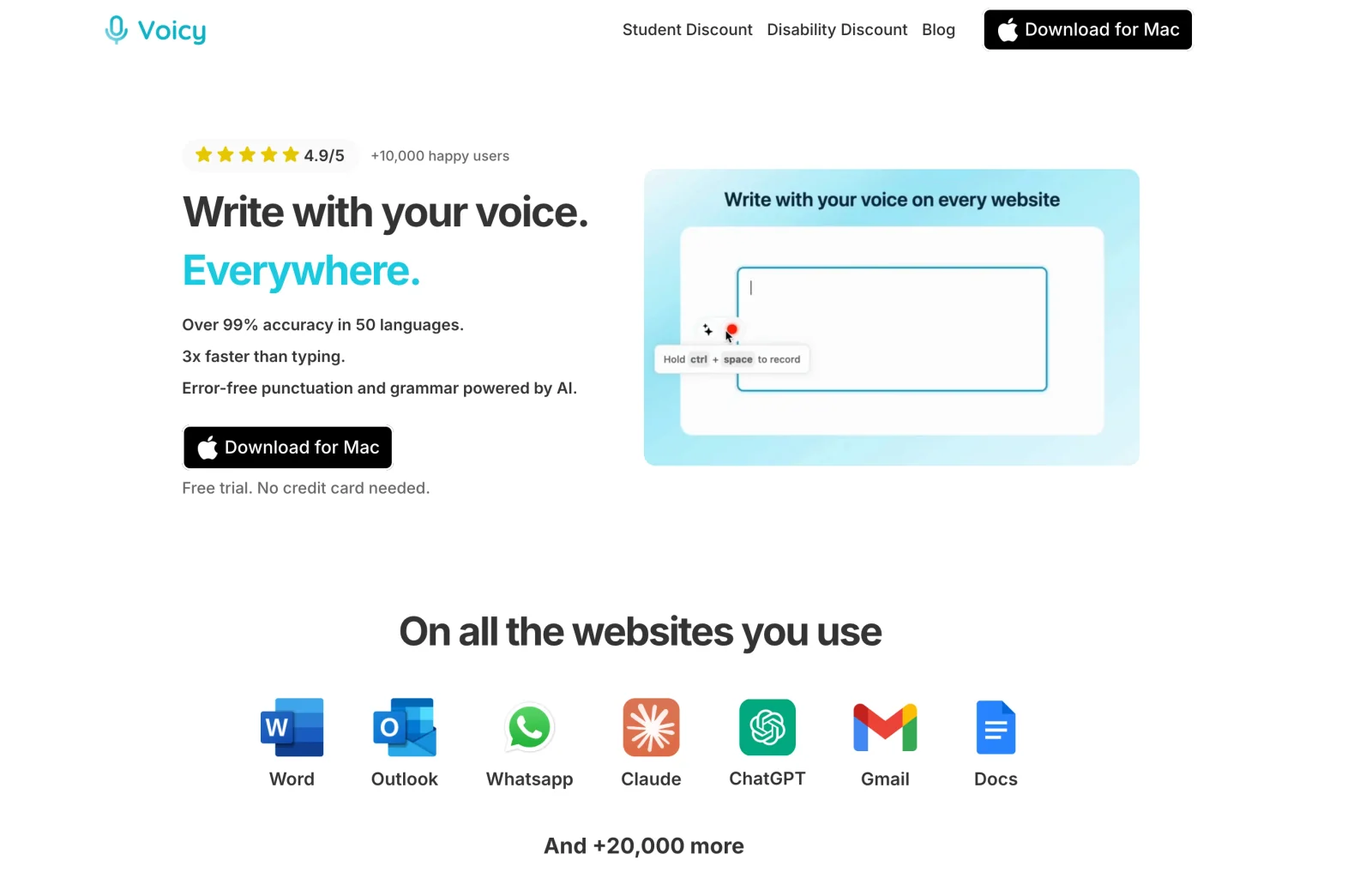
Voicy turns speech into clean, punctuated text in any app. Press one shortcut and talk into Outlook, Gmail, Word, Google Docs, Slack, PowerPoint or a web portal. It works on Mac, Windows and Linux, with apps for iPhone and Android and a browser extension.
In A Doctor's Week
Between clinics, dictate the reply to a colleague's email and the rota message to your team. In the evening, speak the next section of a review article in Word, then the speaker notes for Grand Rounds. On the train, dictate a CME reflection on your phone. None of this needs a scribe, and all of it is faster spoken than typed. Voicy says people speak about three times faster than they type.
Key Features
Works in every app: no integration project. If you can click into a text field, you can dictate into it.
Automatic punctuation and formatting: Voicy adds commas, full stops and paragraphs as you speak, so drafts need less cleanup.
Dictionary: add drug names, eponyms, colleagues' names and terms Voicy mishears. It holds up to 600 characters, so add the words that actually go wrong.
Voice shortcuts: say a short phrase and Voicy types a saved paragraph, such as a standard email signature or a teaching-session outline.
Rewrite Mode: turn rough spoken notes into a polished email or summary.
Offline mode: in the Mac, Windows and Linux apps, the speech model runs on your computer and normal dictation audio stays on your device.
File transcription: upload a recorded lecture or interview of up to 60 minutes on a paid plan.
50+ languages online: useful for international colleagues and multilingual teaching.
Pros
One shortcut for email, documents, slides and web forms
Every platform a doctor uses: Mac, Windows, Linux, iPhone, Android and browser
Offline mode on desktop for plain dictation
A year costs less than one month of most scribes
Free trial with every feature and no card
Cons
Not a scribe: it does not listen to visits or draft clinical notes.
No BAA, so patient information stays out of it.
No medical vocabulary pack; the Dictionary is capped at 600 characters.
Rewrite Mode and file transcription need internet.
Pricing
Voicy's free trial includes 30 minutes of recording and every feature, with no credit card. Paid plans are $8.49 a month, $82 a year or $260 for a lifetime licence, and one plan covers all your devices. Teams start at $6.79 per user per month for three or more users. Students and people with disabilities get 20% off.
Best For
Doctors who already have a scribe for visits and still type for hours afterwards.
Academic clinicians writing papers, grants, lectures and reviews.
Practice owners and managers handling staff email, policies and admin.
Mac and Linux users who can't run Windows-only medical dictation.
Ambient Scribes For Solo Clinicians And Small Practices
These five publish prices and let one clinician start without a procurement process.
2. Freed: Best Ambient Scribe For Small Practices
Freed records the visit and drafts a SOAP note in your specialty's format. It is built for independent clinicians, and its pricing page lets you start a trial without talking to sales.
Plans: the pricing page lists Starter at $39 a month billed annually or $59 month to month, for one clinician and up to 40 notes a month. Core, at $79 a month, adds unlimited notes. Premier, at $104 a month billed annually or $119 monthly, adds EHR push into browser-based EHRs, ICD-10 and CPT suggestions, patient instructions, referral letters and saved dictation phrases. Groups is custom-priced with an organization-wide BAA.
Trial: seven days, no card. Core is free for residents and students through an application form.
Pros
Clear self-serve plans and a no-card trial
Referral letters and patient instructions on Premier
Free Core plan for residents and students
Cons
Starter caps you at 40 notes a month
EHR push is Premier only and covers browser-based EHRs
BAA terms for individual plans need confirming
3. Heidi: Best Free Plan
Heidi combines an ambient scribe, dictation, evidence questions and coding help. Its Free plan lets you test notes in your own specialty before you pay, with a weekly usage allowance.
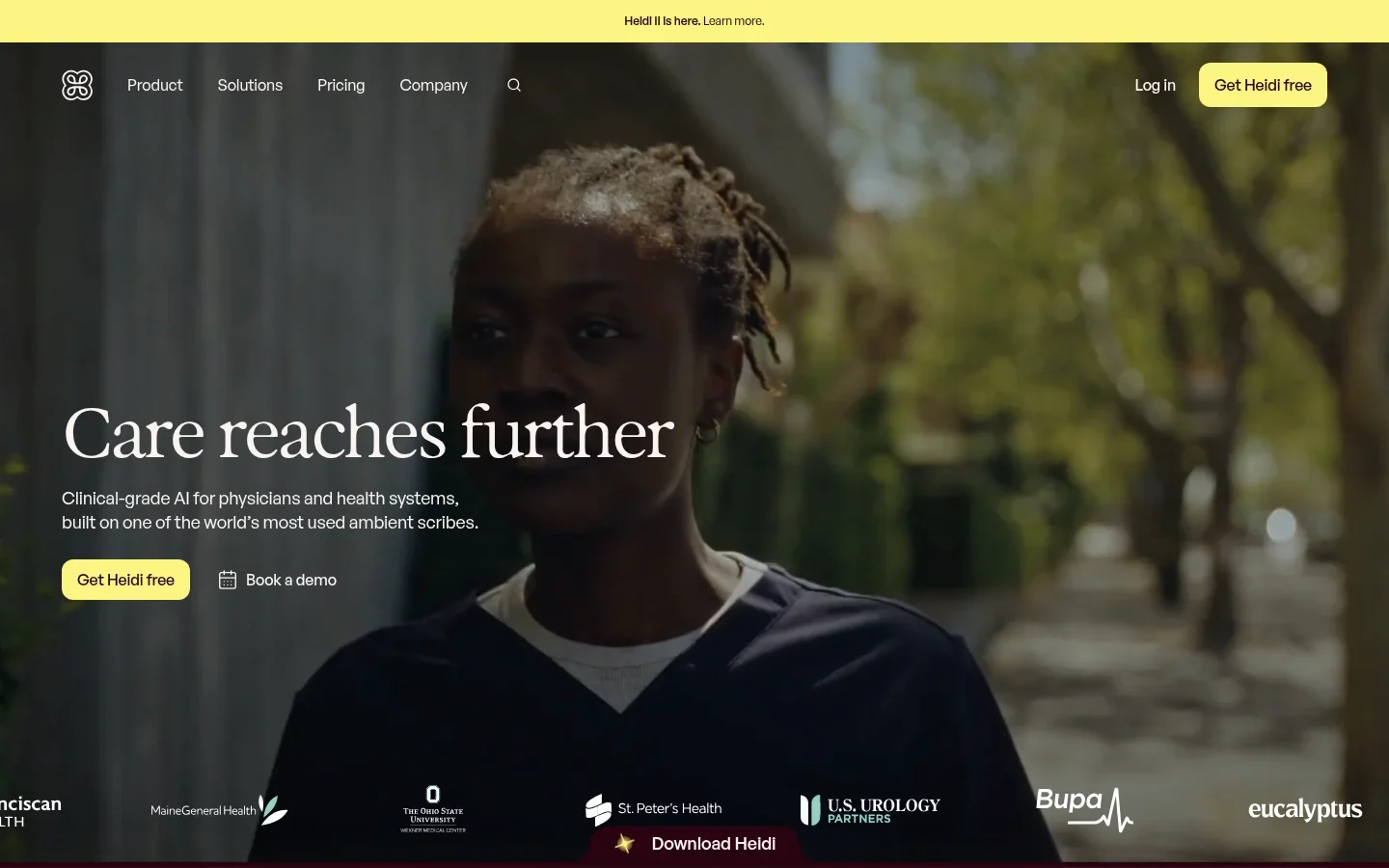
Plans: the pricing page lists Free, Clinician and Teams. Clinician has a 14-day free trial. EHR integration is listed under Teams. The Clinician plan costs $150 a month, or $110 a month billed yearly, for a Standard seat; a Max seat with higher usage limits is $409 a month or $299 billed yearly. Practice seats are $180 a month billed yearly.
Platforms: web, plus Heidi Desktop for Mac and Windows.
Privacy: Heidi's US HIPAA page says it makes a BAA available to covered entities. A free account is not automatic approval to record patients.
Pros
A real free plan for testing
Desktop apps for Mac and Windows
Scribe, dictation and evidence questions in one tool
Cons
EHR integration only on Teams
Plan matrix is detailed; some features have usage caps
4. Twofold: Best BAA On Every Account
Twofold captures live sessions, dictation, typed notes or uploaded audio, and drafts SOAP, DAP or BIRP notes. It is popular with therapists and outpatient clinicians who want a low price with the paperwork sorted.
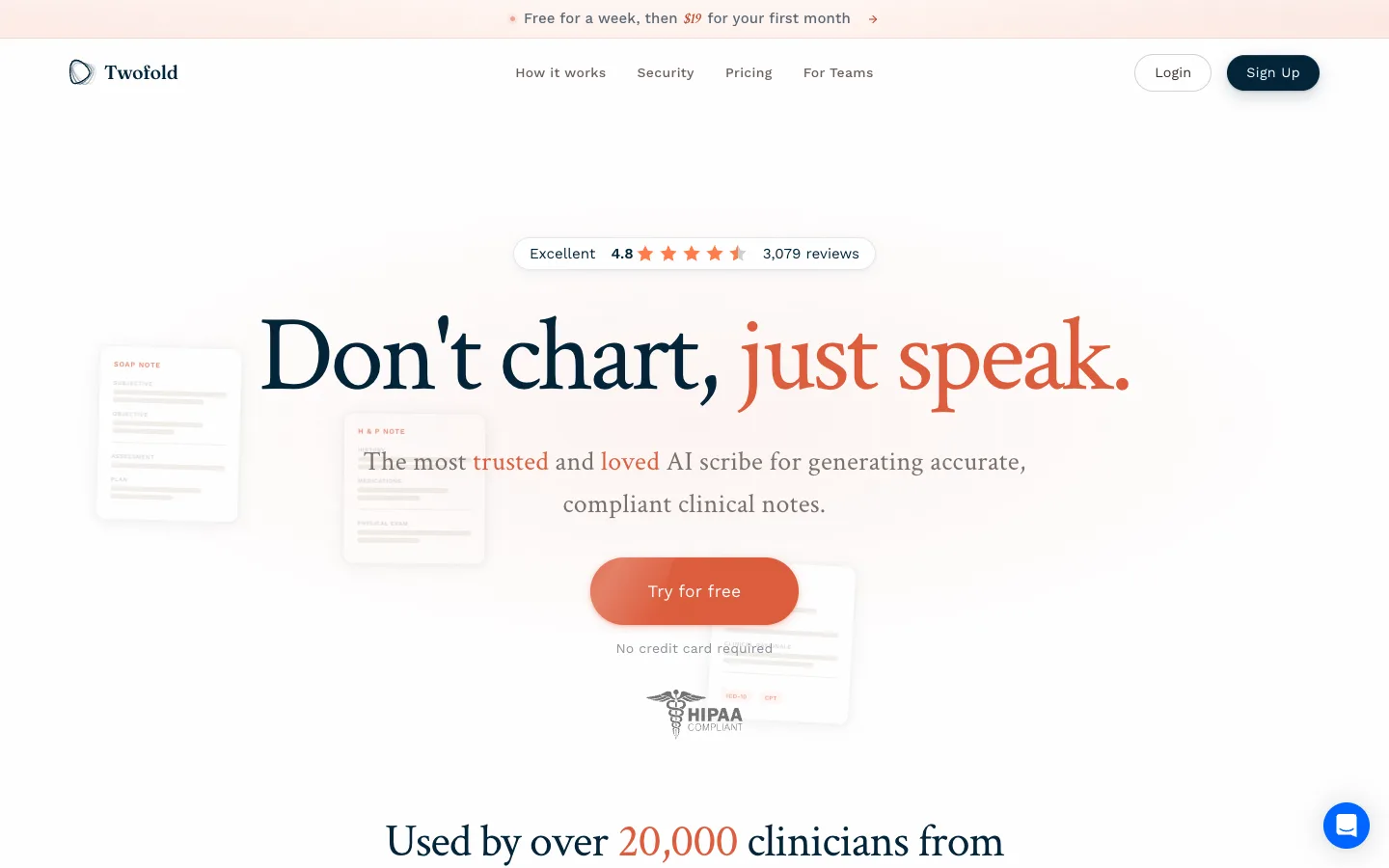
Plans: a free first week with no card, then the Personal plan at $69 a month, or $49 a month billed annually ($588 a year). The first paid month is discounted. The pricing page says a signed BAA is included on every account at no extra cost. Group pricing is custom.
EHR: Twofold says notes work with any EHR, including Epic, Cerner, Athena and SimplePractice, by copying the finished note. That is not a native write-back.
Pros
Signed BAA included on every account
Web, iOS and Android apps
ICD-10 and CPT suggestions, referral and follow-up letters
Cons
No native EHR write-back; you paste the note
Promotional pricing changes often; confirm the ongoing rate
5. Scribeberry: Best Published EHR List For The Price
Scribeberry drafts notes, letters and forms from patient conversations. It names more EHRs on its site than most self-serve scribes, including Canadian systems.
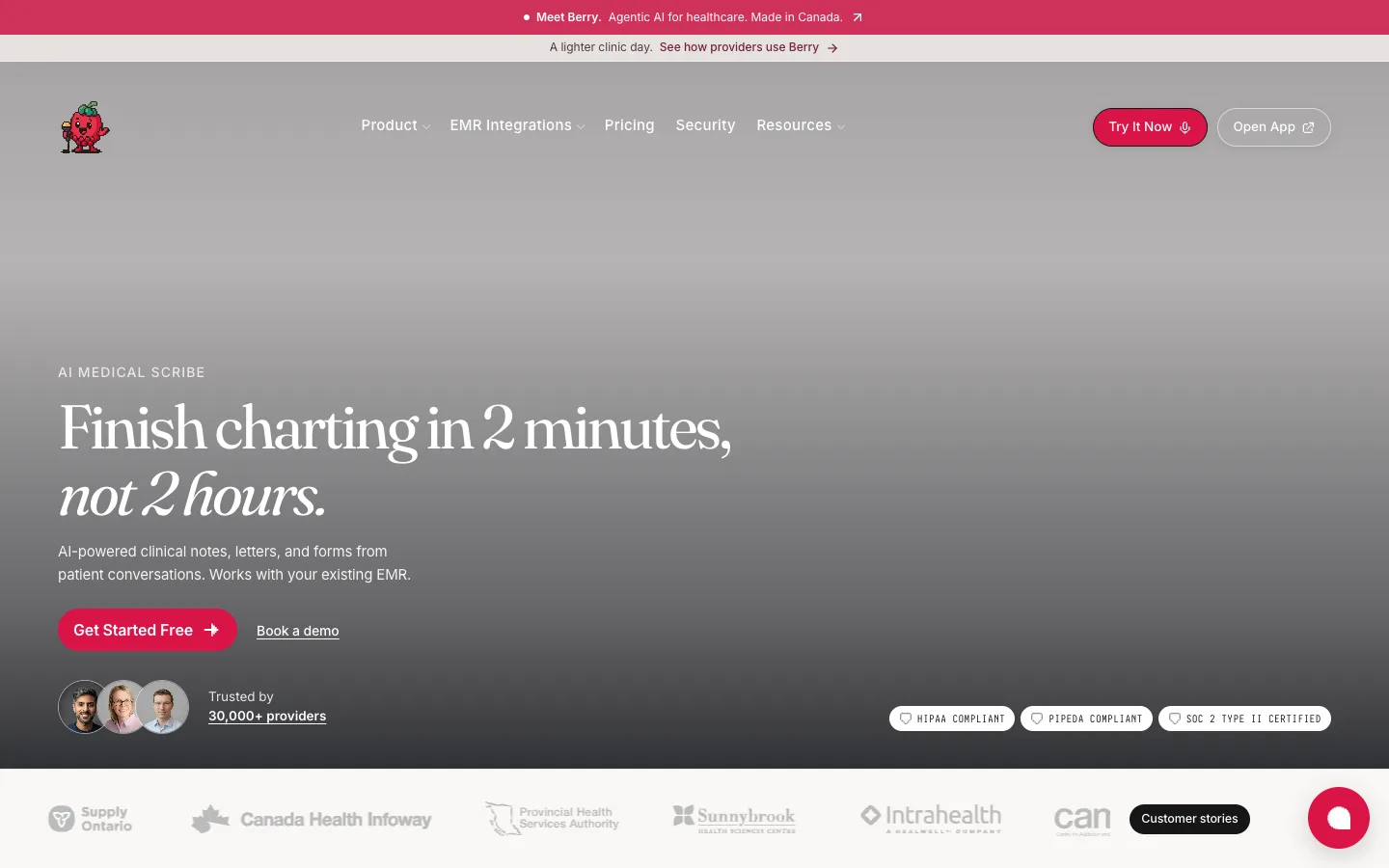
Plans: the pricing page lists Pro at $99 a month or $999 a year, and Enterprise at $79 per user per month for five or more providers. The trial gives three days of unlimited use, then 20 uses a month, with no card.
EHR: Epic, Oracle Health, athenahealth and eClinicalWorks in the US, plus Accuro, OSCAR Pro, TELUS CHR, Jane App and others in Canada.
Privacy: the site claims HIPAA and PIPEDA compliance and SOC 2 Type 2 certification. Ask for the BAA before recording US patients.
Pros
Named US and Canadian EHR integrations
Web, desktop, mobile and Chrome extension
Permanent limited free tier
Cons
$99 a month is higher than Freed Starter
BAA terms are not on the pricing page
6. Sunoh.ai: Best For Named EHR Sync At A Fixed Price
Sunoh.ai listens to the visit, drafts the progress note and captures orders. It publishes one per-user price and names seven EHRs.
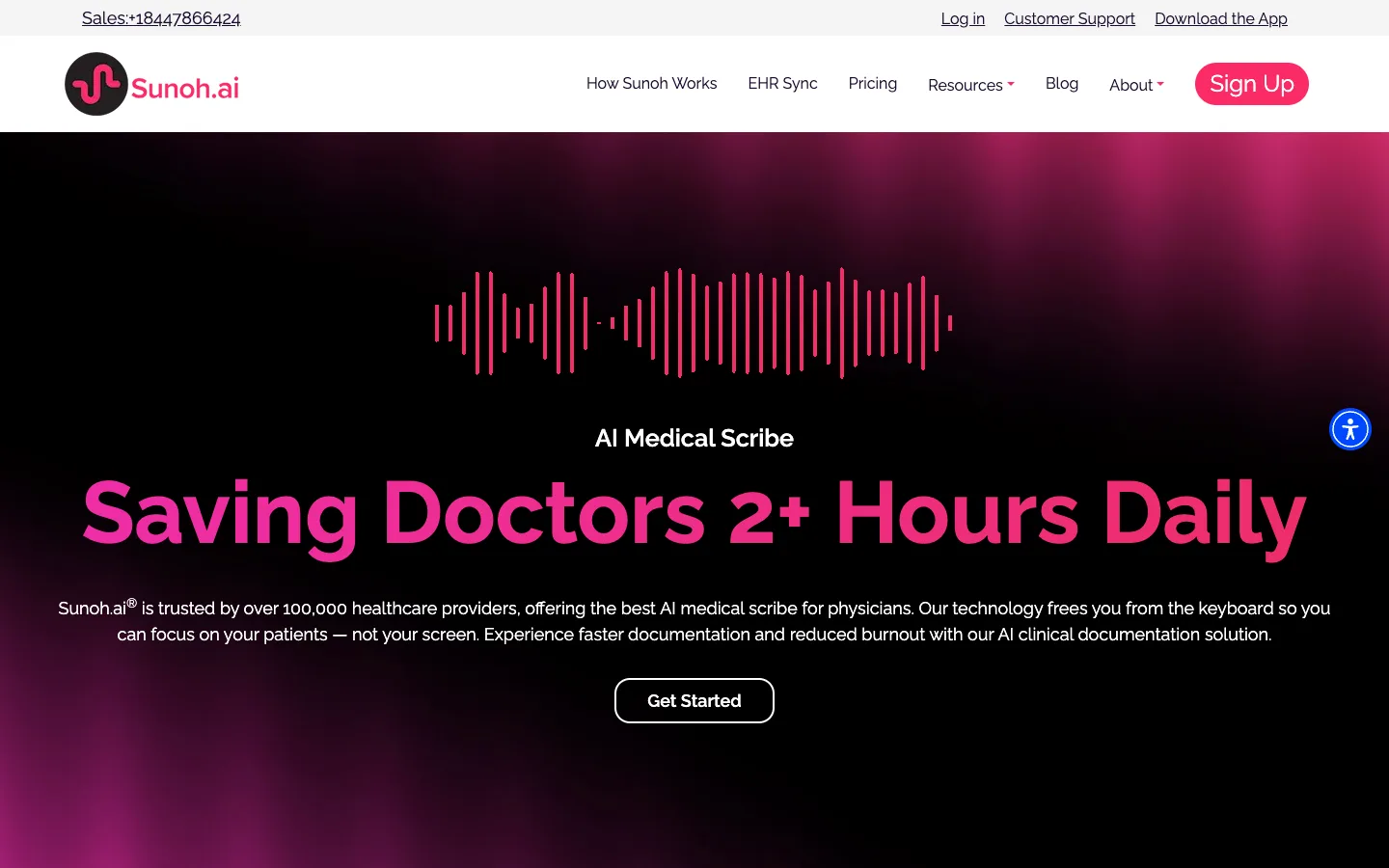
Plans: the pricing page says "starting at $149 per user per month" for a limited time, with no long-term commitment and a free trial. A BAA is included.
EHR: athenahealth, Cerner, eClinicalWorks, Epic, ModMed, Practice Fusion and Tebra, plus an EHR Sync browser extension for other browser-based systems.
Pros
Seven named EHRs and a sync extension
BAA included, no long-term contract
Order capture as well as notes
Cons
The $149 rate is labelled as limited-time
Higher than Freed, Twofold and Scribeberry
Ambient Scribes For Health Systems
These vendors sell through an organization contract. Expect a demo, a pilot and an integration project rather than a credit-card signup.
7. Abridge: Best For Enterprise Documentation
Abridge documents clinician and nursing encounters, prepares visits, improves coding specificity and drafts patient summaries. It is built for health-system rollouts with implementation support.
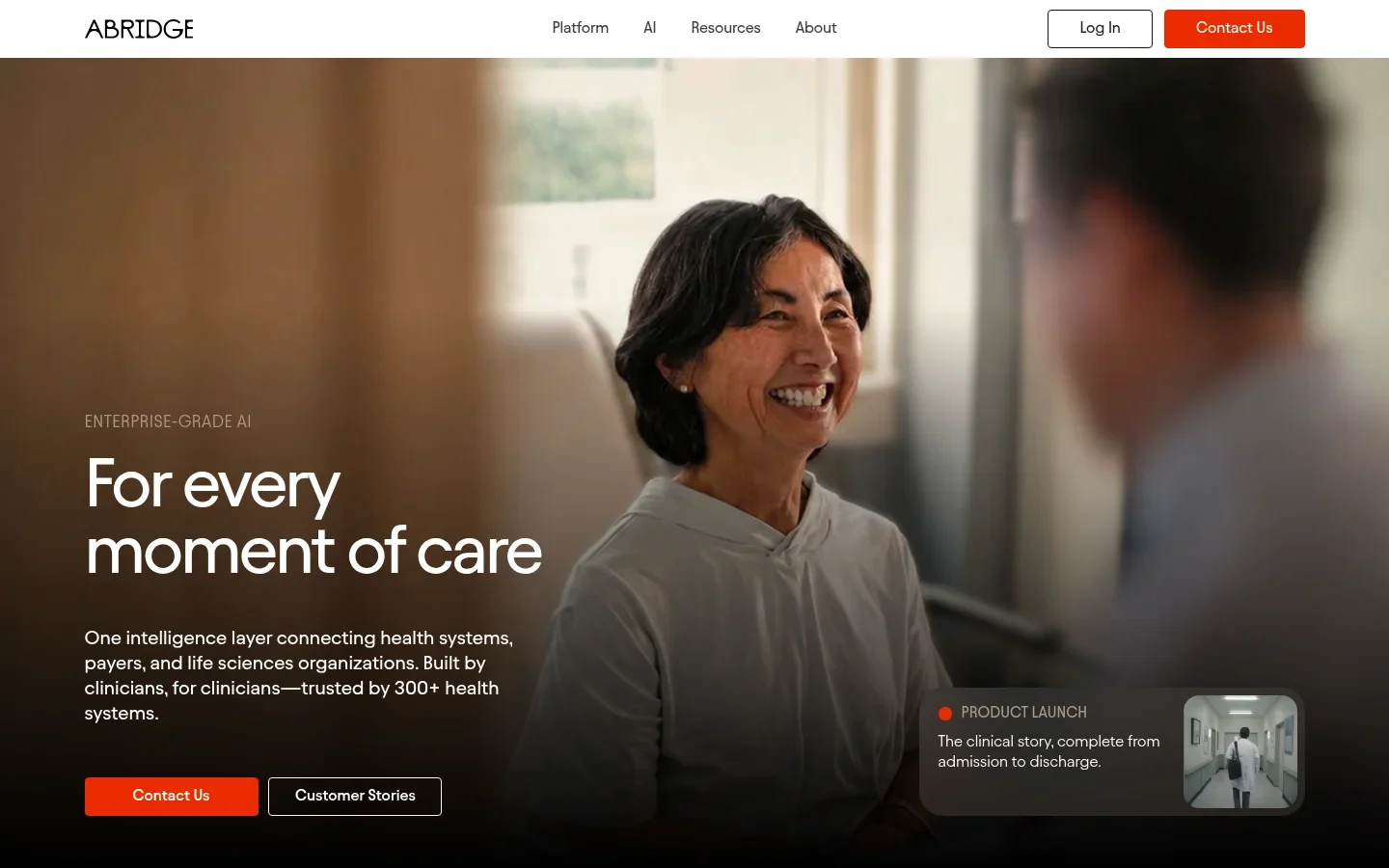
Pricing: about $2,500 per clinician per year, roughly $208 a month, on an enterprise contract.
Before you buy: test speaker attribution, medications and the path from draft to signed note in your own pilot. Abridge's privacy policy says customer-data retention follows the customer agreement.
Pros
Built for organization-wide rollout
Nursing, coding and revenue-cycle products alongside notes
Cons
About $2,500 per clinician per year, through sales
Not available to a solo clinician off the shelf
8. Microsoft Dragon Copilot: Best For Ambient Plus Dictated Additions
Dragon Copilot generates draft documents from ambient recordings and lets you add dictated information. It is Microsoft's successor to DAX Copilot, and it is not the same product as basic Dragon Medical One dictation.
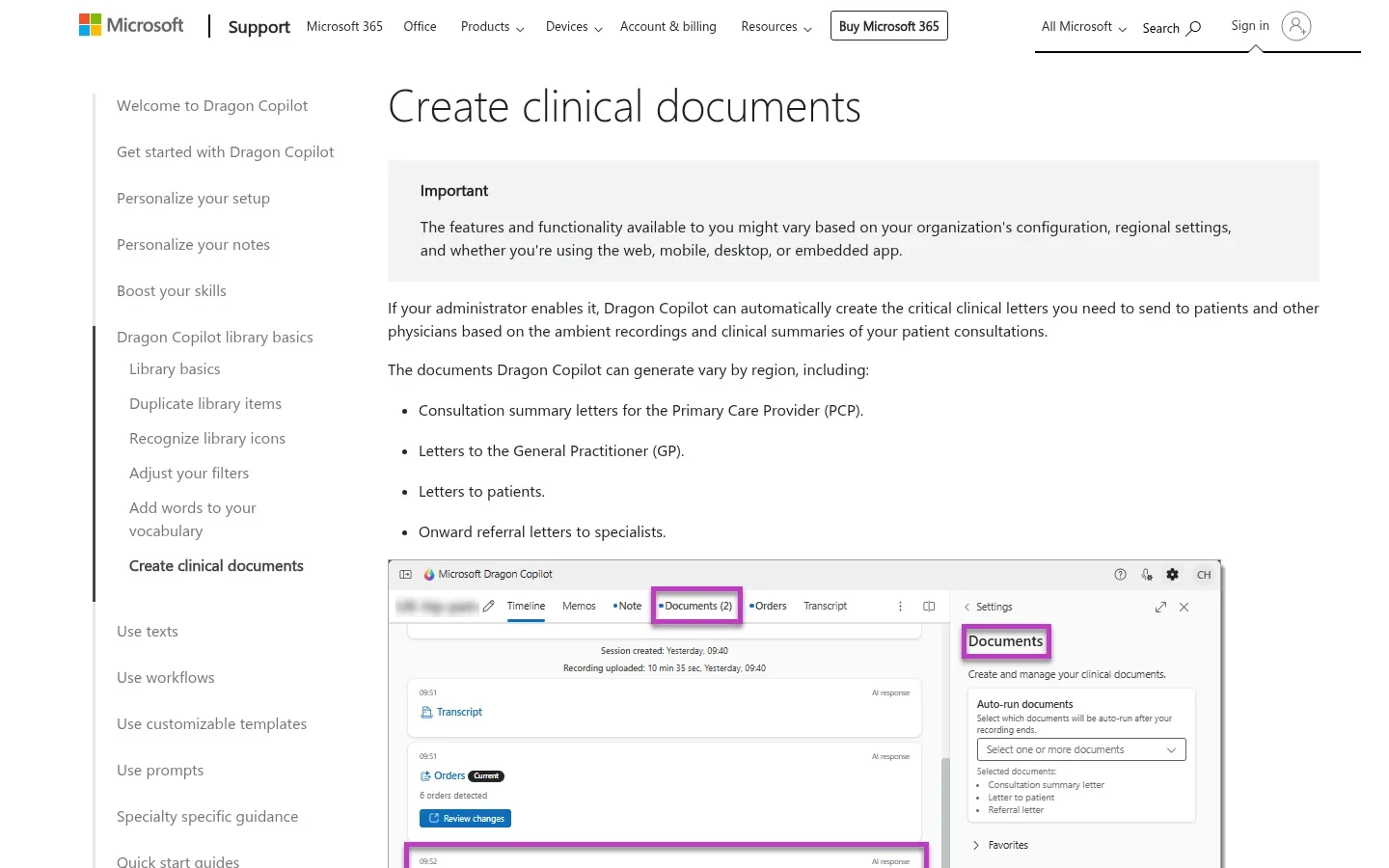
Pricing: about $150 per user per month on an annual term ($1,800 a year), or $157.50 paid monthly, with ambient use billed per encounter on top. Bought through Microsoft or a partner.
Watch for: Microsoft's guide says a newly generated document version does not automatically keep edits you made to an earlier one. Include that in training.
Pros
Ambient capture and dictation in one workflow
Fits organizations already on Microsoft clinical tools
Cons
Ambient encounters billed on top of the seat price
Regenerating a note can drop earlier manual edits
9. Suki: Best For Notes Plus Orders And Coding
Suki covers ambient notes, dictation, patient instructions, orders and coding. It suits organizations that want one assistant for more than the visit note.
EHR: Epic, Oracle Health, athenahealth and MEDITECH, per Suki's site. Desktop plus iOS and Android apps.
Pricing: about $299 per user per month for Suki Compose and $399 for Suki Assistant. Ask which features are live in your EHR and specialty.
Pros
Four major EHRs named
Directed dictation alongside ambient notes
Cons
One of the higher per-seat prices here
A broad assistant means more implementation decisions
10. Nabla: Best Configurable Health-System Workflow
Nabla offers ambient documentation, dictation, E/M and ICD-10 coding and pre-charting, with organization-level configuration.

EHR: Epic, athenahealth, Oracle, NextGen and Greenway logos on its site. Web, iOS, Android and a Chrome extension.
Pricing: a free trial through its web app, then about $119 per clinician per month.
Pros
Every platform, including a Chrome extension
Free trial before a sales conversation
Cons
Sold through sales after the trial
Confirm your exact EHR version is covered
11. DeepScribe: Best For Oncology
DeepScribe is an ambient scribe built for oncology and specialty care, with pre-visit prep and E/M, ICD-10 and HCC coding.
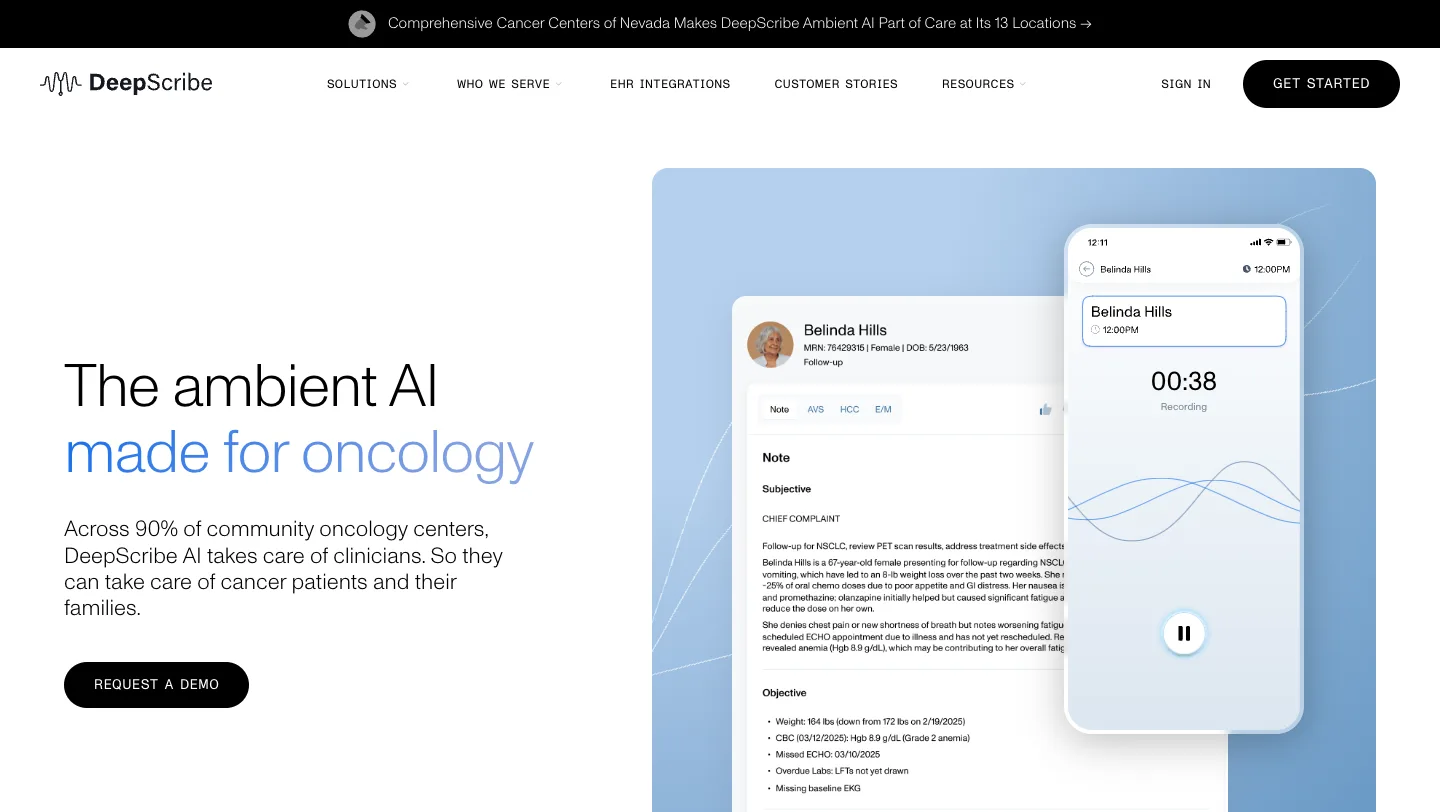
EHR: Epic, plus embedded workflows inside OncoEMR and iKnowMed.
Pricing: about $350 to $750 per provider per month, depending on specialty and volume.
Pros
Deep oncology focus and embedded oncology EHR workflows
Coding support for E/M, ICD-10 and HCC
Cons
Narrow specialty focus
The highest price range here, with no self-serve trial
AI Medical Scribe Cost Compared
Prices for one clinician, checked November 10, 2026. Enterprise prices are typical figures; your contract may differ.
| Tool | Monthly | Yearly | What the price covers |
|---|---|---|---|
| Voicy | $8.49 | $82 (or $260 lifetime) | Dictation and writing on every device; not visit notes |
| Freed Starter | $59 | $468 ($39/month) | Up to 40 visit notes a month |
| Freed Premier | $119 | $1,248 ($104/month) | Unlimited notes, EHR push, coding, letters |
| Scribeberry Pro | $99 | $999 | Notes, letters and forms; named EHRs |
| Sunoh.ai | From $149 | From $1,788 | Notes, orders, EHR sync, BAA |
| Freed Core | $79 | $948 | Unlimited visit notes |
| Twofold Personal | $69 | $588 ($49/month) | Notes, letters, coding, BAA included |
| Heidi Clinician | $150 | $1,320 ($110/month) | Scribe, dictation, evidence; EHR on Teams |
| Nabla | About $119 | About $1,428 | Ambient notes, dictation, coding |
| Dragon Copilot | About $157.50 | About $1,800 | Ambient plus dictation; per-encounter ambient extra |
| Abridge | About $208 | About $2,500 | Enterprise documentation and implementation |
| Suki | About $299 to $399 | About $3,588 to $4,788 | Notes, orders, coding, dictation |
| DeepScribe | About $350 to $750 | About $4,200 to $9,000 | Specialty and oncology notes, coding |
A year of Voicy costs less than one month of most scribes, which is why doctors add it next to a scribe rather than instead of one.
Which Setup Fits Your Practice?
You Are A Solo Clinician
Trial Freed, Heidi and Twofold on the same set of synthetic visits and compare review time. Add Voicy for email, letters to colleagues and everything you write after clinic.
You Run A Small Group Practice
Shortlist Scribeberry and Sunoh if your EHR is on their lists, and Freed Groups for an organization-wide BAA. Voicy Team gives everyone the same dictation shortcut for admin and email at $6.79 per user per month.
You Work In A Health System
Your organization will run the scribe procurement: Abridge, Dragon Copilot, Suki or Nabla. Use Voicy for the writing that sits outside the chart, such as teaching, committee papers and research.
You Are In Oncology
Start with DeepScribe for its OncoEMR and iKnowMed workflows.
You Teach, Research Or Write For Publication
A scribe won't help with a manuscript. Voicy will: dictate drafts in Word or Google Docs, then use Rewrite Mode to tidy the wording.
Before You Buy: Five Checks For Clinical Use
1. Is The BAA On Your Plan?
For a US covered entity, the vendor that handles PHI needs a business associate agreement. Check the plan, not the homepage badge. Use the HHS business associate guidance as your starting point.
2. How Do You Get Patient Consent?
Recording rules vary by state and care setting. Follow your organization's consent process, tell patients what is recorded, and offer an alternative if they decline.
3. Where Does The Note Go?
Ask for a live demonstration in your EHR version. Native write-back, a browser push and copy-paste are different workflows with different error risks.
4. What Is Kept, And For How Long?
Ask separately about audio, transcripts, draft notes, backups and model training. "Zero retention" can mean different things for each.
5. How Long Does Review Take?
Time the full process: recording, review, correction and signing. A long, polished draft can still miss a negative finding or attribute a family member's history to the patient.
Fast Answer: What Is The Best AI Medical Scribe For Doctors?
For visit notes in a small practice, start with Freed, Heidi or Twofold. If you need named EHR integrations at a published price, compare Scribeberry and Sunoh. Health systems should run a pilot with Abridge, Dragon Copilot, Suki or Nabla, and oncology practices should look at DeepScribe. For everything doctors write outside the chart, use Voicy.
Frequently Asked Questions
What is the best AI medical scribe for doctors in 2026?
For a solo clinician or small practice, Freed, Heidi, Twofold, Scribeberry and Sunoh publish self-serve plans. For a health system, Abridge, Microsoft Dragon Copilot, Suki, Nabla and DeepScribe sell through an organization contract. For the writing around patient care, such as emails, teaching material and research drafts, Voicy is the fastest and lowest-cost option.
What is the difference between an AI medical scribe and dictation?
An ambient AI medical scribe listens to the patient visit and drafts a structured note from the conversation. Dictation types the words you deliberately speak. Most doctors need both: a scribe for visit notes, and dictation for emails, letters, presentations and everything else they write.
How much does an AI medical scribe cost?
Self-serve plans range from free tiers to about $150 per clinician per month. Freed Starter is $39 per month billed annually, Scribeberry Pro is $99 per month, and Sunoh starts at $149 per user per month. Enterprise scribes cost more: Dragon Copilot is about $150 per user per month on an annual term, Suki about $299 to $399, and Abridge about $2,500 per clinician per year.
Is there a free AI medical scribe?
Heidi has a Free plan with a weekly allowance, Twofold has a free first week, and Scribeberry gives three days of unlimited use followed by 20 uses a month. Free access does not replace your organization's approval to record patients.
Do AI medical scribes sign a BAA?
Several publish it. Twofold includes a signed BAA on every account, Sunoh includes a BAA, Freed lists an organization-wide BAA on its Groups plan, and Heidi publishes a HIPAA page offering a BAA. For enterprise vendors, the BAA is part of the contract. Confirm the plan and terms in writing.
Which AI scribes integrate with Epic?
Vendor sites name Epic for Sunoh, Suki, Nabla, DeepScribe and Scribeberry. Freed uses a browser-based EHR push, and Twofold output is copied into any EHR. Ask for a demonstration in your exact EHR version, because a logo on a website is not a tested integration.
Do doctors still need to review AI scribe notes?
Yes. Review every draft before signing: medications, doses, allergies, negations, laterality, who said what, and the plan. Check for omissions as well as wrong words, and check what happens to your edits if the tool regenerates a note.
Can doctors use Voicy for patient notes?
No. Voicy does not sign a BAA and is not clinical documentation software, so keep patient information out of it. Doctors use Voicy for the writing around patient care: emails to colleagues, teaching slides, CME notes, research papers, grant applications and practice admin.
Related Guides For Doctors
Best medical dictation software for dictated clinical notes.
Dragon Medical One pricing, including setup fees and contract terms.
Dictation software for medical professionals and how to set it up.
Best radiology dictation software for reporting workflows.
Final Verdict
An AI medical scribe is worth it when your organization has approved the vendor, the BAA and the consent process, and when review time is shorter than charting by hand. Freed, Heidi and Twofold are the easiest places for an individual clinician to start. Health systems should pilot Abridge, Dragon Copilot, Suki or Nabla against the same visits.
The visit note is only part of a doctor's writing. For emails, letters to colleagues, teaching, research and admin, Voicy gives you one shortcut on every device for less than a single month of most scribes. Try it free with your next email.