





Bilingual Dictation on Voicy and Why It Matters
TL;DR
Bilingual dictation matters because many people do not speak in one language at a time.
They mix English with Spanish, Russian, Hindi, Arabic, French, or another language inside the same sentence.
A good transcript should keep the speaker's real words, names, and scripts instead of translating or "fixing" them without being asked.
Voicy supports cloud transcription for live dictation and file uploads on Mac, Windows, Browser Extension, iOS, and Android, with a free trial.
Bilingual dictation is speech-to-text for people who move between two or more languages while they talk. It matters because mixed-language speech is normal for millions of people, especially at work, school, home, and online.
When a transcription app changes "vamos to the meeting" into plain English, turns a name into a common word, or drops a foreign-script phrase, it can change what the speaker meant. The best dictation tools should respect the words people actually said.
Most dictation apps were built around a simple idea: choose a language, press record, and speak in that language.
That works for some people. It does not work for everyone.
Plenty of people speak like this: "Can you send the invoice hoy?" Or, "I told him это срочно, but he missed it." That is not messy speech. It is real speech.
For multilingual people, bilingual dictation is not a bonus feature. It is how notes, messages, meeting summaries, and family chats need to work.
What Is Bilingual Dictation?
Bilingual dictation means turning speech into text when the speaker uses more than one language. The switch can happen between sentences, or inside one sentence.
Researchers call this code-switching. In simple words, it means changing languages during speech. A 2022 review in Applied Sciences describes code-switching as speech with two or more languages in one utterance, and notes that it remains a hard problem for speech recognition systems.
Here are normal examples:
"Let's book it para mañana."
"The client said спасибо and left."
"I need the رقم الطلب before I can help."
"Can you make it more kawaii but still professional?"
Some of those switches are about speed. Some are about culture. Some words just feel more exact in one language than another.
Why So Many People Mix Languages
Language mixing is common because people live across language lines. They work in English, speak another language at home, read a third language online, and use names or phrases that do not translate cleanly.
English is a big part of this. The English language is widely described as having more second-language speakers than native speakers. Estimates vary, but the core point is clear: English is often a bridge language, not a home language.
That changes how people talk.
A Spanish-English speaker may use English for software terms and Spanish for emotion. A Russian-English speaker may keep Russian names in Cyrillic. An Arabic-English speaker may move between English words and Arabic script because both belong in the same message.
This is not rare. It is daily life for many families, students, founders, doctors, creators, support teams, and remote workers.
Why Mixed-Language Speech Is Hard For Transcription Apps
Mixed-language speech is hard because the app has to solve several problems at once. It has to hear the words, know which language they belong to, keep the right script, and avoid over-editing.
Language can switch without warning
A person may start a sentence in English and end it in Spanish. There may be no pause. The app cannot rely on a clean handoff.
That is a problem for speech systems that expect one language at a time. If the app thinks the whole sentence is English, it may force non-English words into English-looking words.
Names do not follow normal rules
Names are often the first thing to break. A person's name may sound like a common word in another language. A city name may have more than one spelling. A company name may mix Latin letters with another script.
If a transcript damages a name, the whole note can become less useful. In a sales call, a class note, a medical note, or a legal memo, names matter.
Scripts carry meaning
Some languages can be written in more than one way. A Russian speaker may expect Cyrillic. A Hindi-English speaker may use Devanagari, Latin letters, or both. Arabic, Japanese, Korean, Chinese, Greek, and Hebrew all bring script choices into the transcript.
When an app transliterates a word without asking, it may make the text easier for one reader and worse for another. "Spasibo" is not the same reading experience as "спасибо."
Why Word Error Rate Does Not Tell The Whole Story
Word error rate, often called WER, is a common way to score speech recognition. It counts words that are wrong, missing, or added.
That is useful, but it is not enough for bilingual dictation.
A Reddit discussion that inspired this post pointed to a Russian-English benchmark where simple WER missed important problems: transliteration, translation, missing chunks, damaged names, and post-processing changes. We are treating that benchmark as a seed insight here, not as a Voicy-tested result.
The broader research points in the same direction. A 2023 paper, Benchmarking Evaluation Metrics for Code-Switching Automatic Speech Recognition, focuses on the need to evaluate code-switching ASR more carefully. Another arXiv paper on code-switched speech recognition describes models that transcribe speech with two or more alternating languages in a conversation.
For a user, the issue is simple. A transcript can have a decent score and still feel wrong.
Here is how that can happen:
Translation: the app changes a foreign phrase into English, even though the speaker wanted the original words.
Transliteration: the app writes "spasibo" when the speaker expected "спасибо."
Missing chunks: the app skips the non-English part because it does not know what to do with it.
Damaged names: the app turns a person, place, or brand name into a similar-sounding common word.
Post-processing drift: the app "cleans up" the sentence so much that the speaker's actual wording disappears.
Everyday Places Where Bilingual Dictation Matters
Bilingual dictation is not only for language researchers. It shows up in normal work and normal life.
Messaging family and friends
Many people use one language for family and another for work. A message may include English calendar words, local slang, and a family phrase that should stay exactly as spoken.
If dictation flattens that into one language, the message can sound stiff or wrong.
Work notes and client follow-ups
Remote teams often use English as the shared work language. But names, project terms, country terms, and client phrases may come from other languages.
A transcript that keeps those details saves cleanup time. It also makes the note easier to trust later.
School and study notes
Students often learn in one language and think in another. They may dictate a note like: "The main idea is supply and demand, pero the example from class was about rent."
That mixed note may be the clearest version for the student. The transcript should not force it into a language they did not use.
Healthcare and care notes
Care notes often include names, symptoms, medicine names, and family details. Some of those words may be in another language.
This is a place to be careful. Dictation can help with first drafts and notes, but users should review important medical text before sharing or storing it.
What A Good Bilingual Dictation Tool Should Preserve
A good bilingual dictation tool should preserve meaning first. That means it should keep the speaker's words, language switches, scripts, names, and sentence shape as well as it can.
Look for these signs:
It can handle more than one language in real speech, not just a clean demo sentence.
It keeps foreign words instead of always translating them.
It protects names, places, and brand terms.
It respects scripts when the speaker expects them.
It gives you a clean transcript, but does not rewrite your meaning away.
It works where you already write, such as documents, chat, email, and browser apps.
This is also why editing controls matter. No transcription app is perfect. The transcript should be easy to review and correct.
How Voicy Fits Bilingual Dictation
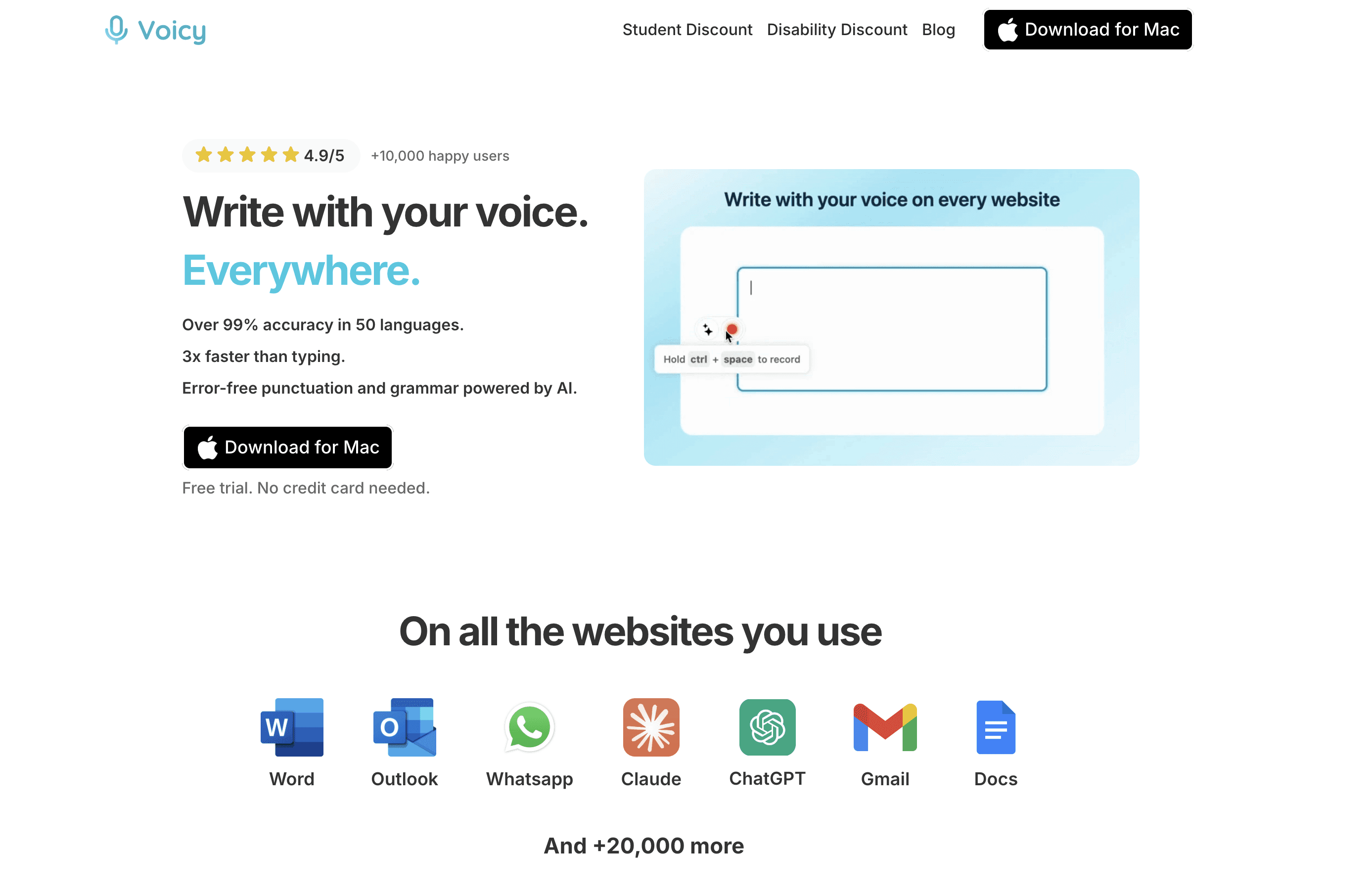
Voicy is built for people who want to speak instead of type across their daily apps. It supports cloud transcription, live dictation, and file upload transcription.
You can use Voicy on Mac, Windows, the Browser Extension, iOS, and Android. That matters for bilingual speakers because language mixing does not only happen in one place. It happens in email, notes, docs, chats, and browser tools.
Voicy should be positioned carefully here. We should not claim benchmark wins unless we have run and published them. The stronger promise is more honest: Voicy is part of a future where dictation tools need to handle real multilingual speech, not only neat monolingual samples.
If you already use voice typing for work, see the Voicy voice typing app guide. If you dictate mostly on a Mac, the Mac speech-to-text guide is a useful next read. If you write in docs, the Google Docs speech-to-text guide shows where browser dictation can help.
How To Try Bilingual Dictation In A Practical Way
The best test is not a clean lab sentence. Use your real speech.
Try this simple test:
Pick a note you would actually send.
Speak naturally, including both languages.
Use names, places, and one phrase in a non-Latin script if that is normal for you.
Check whether the transcript kept the original words or changed them.
Mark what happened: correct, translated, transliterated, missing, or over-edited.
This test is small, but it is more useful than a perfect demo. It tells you whether the app respects how you speak.
The Bigger Point: Transcription Should Not Erase Identity
Dictation is not only about speed. It is also about voice.
For multilingual people, voice includes language choice. It includes when you switch. It includes a name written the right way. It includes a phrase that belongs in Arabic, Russian, Hindi, Japanese, Spanish, French, or another language because that is how you meant it.
When transcription tools force everything into one language, they make speech easier for the system but less true to the speaker.
That is why bilingual dictation matters. The future of speech-to-text should not ask people to sound simpler than they are.
FAQ
What is bilingual dictation?
Bilingual dictation is speech-to-text for people who use two or more languages while speaking. It can include full sentences in different languages or mixed-language phrases inside one sentence.
What is code-switching?
Code-switching means changing from one language to another during speech or writing. Many bilingual and multilingual people do this naturally.
Why do people mix languages in one sentence?
People mix languages because some words are faster, clearer, more personal, or more common in one language. Work, family, school, and internet culture can all shape how someone speaks.
Why is bilingual speech hard for transcription apps?
It is hard because the app has to detect language switches, keep names right, choose the right script, and avoid unwanted translation or cleanup.
Should transcription translate my words?
Not unless you ask it to. Dictation should usually preserve what you said. Translation is a different job.
Why does script matter in a transcript?
Script matters because the same word can feel different when written in Latin letters instead of its normal script. For many users, "спасибо" and "spasibo" are not equal.
Does word error rate measure bilingual dictation well?
Word error rate is useful, but it can miss problems that matter to bilingual users. It may not fully show unwanted translation, transliteration, missing chunks, broken names, or over-editing.
Does Voicy support bilingual dictation?
Voicy supports cloud transcription for live dictation and file uploads across Mac, Windows, Browser Extension, iOS, and Android. Users should test their own language pairs and scripts, because real bilingual speech can vary a lot.
Is Voicy free?
Voicy has a free trial, but it is not a fully free app. Current pricing should be checked before publishing if the article includes exact prices.
Final Thought
Bilingual dictation is about respect. It respects how people actually speak, not how software wishes they spoke.
For Voicy, this is a useful product and content direction: help people move faster without asking them to flatten their language. The transcript should sound like the person who spoke it.
Try Voicy with a free trial and test it with your real mixed-language notes, messages, and files.


