




Is ADHD a Learning Disability? A Guide for Clarity
Short version of the article
For those who don't have time to read it all. Read the full article for more guidance.
ADHD is not a learning disability, but they often happen together. The key difference: ADHD affects how you focus and stay organized, while learning disabilities affect how your brain processes specific information like reading or math.
The main distinction:
ADHD: Trouble with attention, organization, and impulse control (executive functions)
Learning disabilities: Difficulty processing words (dyslexia), numbers (dyscalculia), or writing (dysgraphia)
Why the confusion? 30-50% of kids with ADHD also have a learning disability. The symptoms can look similar in the classroom, but the causes are completely different.
Getting help: ADHD is diagnosed by a doctor. Learning disabilities are usually identified through school testing. Under U.S. law, ADHD qualifies as "Other Health Impairment" while learning disabilities have their own category under IDEA.
Support strategies differ. ADHD support focuses on managing attention and organization. Learning disability support targets specific skill gaps like reading or math processing.
Main article: Is ADHD a Learning Disability?
Let's answer the big question right away: Is ADHD a learning disability?
The short answer is no,
ADHD is not a learning disability. But many people think they're the same thing.
That's because they often happen together. Let's learn why they're different but connected.
Understanding ADHD and Learning
Even though ADHD isn't a Specific Learning Disability (SLD), it makes learning really hard. It gets in the way of the skills you need to learn well.
Here's an easy way to think about it.
A learning disability makes it difficult for your brain to process information.
ADHD is different. Your brain is more than capable to process information.
It's about getting that info to your brain effectively without losing focus.
This difference is really important. A kid with ADHD has the brain power to learn. But they have trouble focusing, sitting still, and staying organized.
It's like they keep getting in their own way when trying to learn.
Why Executive Functions Are the Key
Executive functions are like the boss of your brain. They help you plan your day, ignore distractions, remember what you just read, and do many things at once. ADHD makes these important skills much harder:
Working Memory: This is like your brain's sticky note. It helps you remember things for a short time. You need it to follow directions or solve math in your head.
Inhibitory Control: This is your brain's filter. It helps you ignore noise when reading. It also stops you from shouting out answers in class.
Cognitive Flexibility: This skill helps you switch between tasks. Like going from math homework to reading without getting stuck.
These skills are super important for doing well in school.
When ADHD makes them hard, it can look just like a learning disability. Did a student fail a test because they couldn't focus while studying (ADHD)? Or because they couldn't read the words (dyslexia)? The result looks the same, but the cause is totally different.
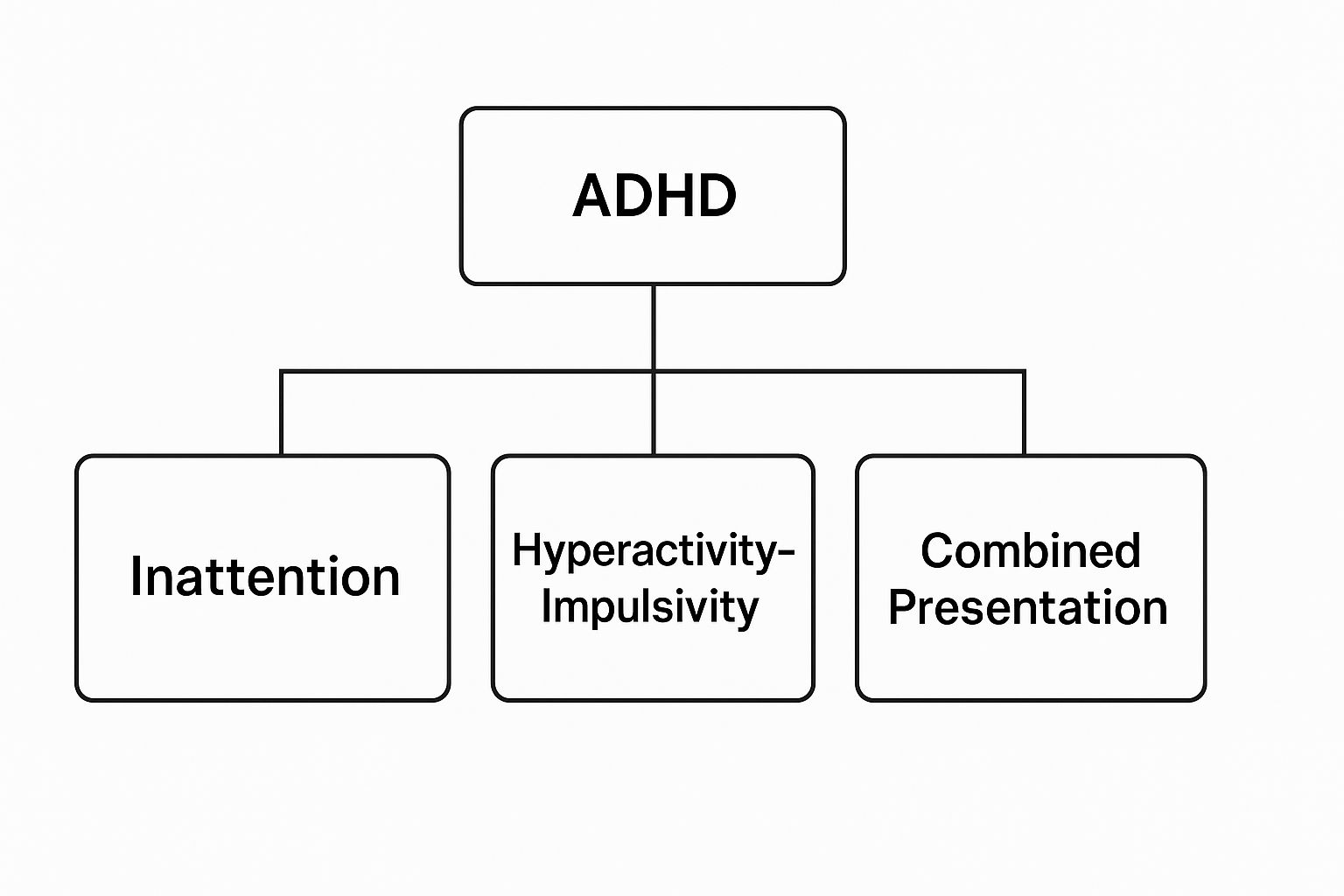
As you can see, ADHD symptoms fall into two groups: not paying attention and being too active or acting without thinking. Both make learning really hard.
To help you understand better, this table shows how they're different.
ADHD vs Learning Disability at a Glance
What We're Looking At | ADHD (Attention-Deficit/Hyperactivity Disorder) | Specific Learning Disability (SLD) |
|---|---|---|
Main Problem | Trouble paying attention, being too active, and acting without thinking. Problems with executive functions. | Trouble working with certain types of information (like words or numbers). |
Type of Challenge | A brain condition that affects self-control and getting things done. | A brain condition that affects how you learn specific skills. |
How It Affects Learning | Makes it hard to get ready to learn (can't focus, start tasks, or stay organized). | Makes it hard to actually learn certain skills (can't read words or understand math). |
Main Signs | Not paying attention, being messy, moving around a lot, acting without thinking. | Having trouble with reading (dyslexia), writing (dysgraphia), or math (dyscalculia). |
This table shows that even though they can look similar in class, the brain problems are different.
ADHD and learning disabilities often happen together. Studies show that 30-50% of kids with ADHD also have a learning disability. This is why getting tested by a professional is so important. Without good testing, you're just guessing what the problem is. Then you can't give the right help.
Want to learn more about the numbers? You can check out learning disability statistics to see how common this overlap really is. You might also find our guide on ADHD productivity tools helpful for managing daily challenges.
To understand why the answer to "is ADHD a learning disability?" is no, we need to look at how these conditions work in real life. Let's think of them as two different characters with their own stories.
ADHD is really about having trouble with regulation.
It doesn't mean you're not smart or don't want to learn. It means you have trouble controlling your attention, stopping yourself from doing things, and managing your energy. This brain condition affects executive functions—the "boss" that helps you plan, organize, and get things done.

This struggle with control shows up in three main ways.
The Three Faces of ADHD
ADHD looks different for different people. That's why it's often misunderstood.
Predominantly Inattentive Presentation: This is the kid who daydreams in class. They might miss important directions and always lose their homework. Big projects feel scary because there are too many parts. It's not that they don't want to do the work. Their brain has trouble filtering out distractions and organizing thoughts.
Predominantly Hyperactive-Impulsive Presentation: This person seems like they have a motor inside them that won't stop. They might fidget all the time, interrupt people, and do things without thinking first. In class, they might shout out answers or find it really hard to stay in their seat.
Combined Presentation: Someone with this type has both kinds of symptoms. They have trouble staying organized and sitting still. This creates lots of daily challenges.
The Main Point: ADHD is about having trouble doing what you know, not trouble knowing what to do. The information is in your brain, but the executive function "bridge" you need to use it is shaky.
This isn't a new idea. Doctors first wrote about ADHD way back in 1902. Today, the Diagnostic and Statistical Manual of Mental Disorders (DSM-5) says ADHD is a neurodevelopmental disorder. It's in a different category from learning disabilities. This shows that ADHD doesn't hurt your brain's ability to learn. But it does make it hard to pay attention and stay organized enough to learn well. You can read about the history and classification of ADHD to learn how our understanding has grown.
What Is a Specific Learning Disability, Then?
Now let's switch gears. If ADHD is a problem with regulation, a Specific Learning Disability (SLD) is a problem with information processing. It's a brain condition that makes it hard to receive, process, store, or share certain types of information.
Unlike ADHD, which affects many parts of life, an SLD is "specific" to certain school skills. A person can be really smart in most ways but have big trouble in one area.
Here are the most common ones:
Dyslexia: This affects reading and understanding language. Imagine your brain sees words as puzzle pieces it has to keep putting together. Someone with dyslexia has trouble reading words, reading smoothly, and spelling right.
Dyscalculia: This affects understanding numbers and math ideas. It's more than just being "bad at math." It's real trouble understanding amounts, number sense, and math thinking.
Dysgraphia: This means big trouble with writing and organizing thoughts on paper. Someone with dysgraphia might have messy handwriting, trouble spelling, and find it really hard to write their ideas clearly.
The key difference is this: ADHD creates barriers to getting education, while an SLD creates barriers in the process of learning itself.
Understanding the Overlap and Look-Alike Symptoms
This is where things get tricky. This is why people get confused about ADHD and learning disabilities. We need to understand two big ideas: comorbidity and symptom mimicry. Understanding these will help us see why getting tested by a professional is so important.

Comorbidity means having two or more conditions at the same time. This happens a lot with brain conditions.
Research shows lots of overlap between ADHD and Specific Learning Disabilities (SLDs). Studies say that between 30% and 50% of people with ADHD also have a learning disability. This isn't rare. It's common and can make getting help harder.
When Symptoms Look the Same
Because they happen together so often, we get symptom mimicry. Many struggles from ADHD look exactly like those from an SLD. But the cause is completely different.
This makes it hard to figure out what's really going on. Is a student having trouble with reading because their attention keeps wandering? Or because their brain can't process the words? The answer changes everything about how you help them.
Let's look at some times when this happens:
Not Finishing Homework: A student might never turn in work. Is it because their ADHD makes it impossible to focus long enough? Or is it because their dysgraphia makes writing so hard they give up?
Not Wanting to Read Out Loud: A kid who hates reading to the class might have different reasons. Maybe their ADHD makes it hard to follow along and wait their turn. Or maybe dyslexia makes them scared of messing up words they can't read.
Being Messy and Disorganized: We know ADHD affects executive function—messy backpacks and lost papers. But being disorganized can also happen with a learning disability. When school takes all your mental energy, there's nothing left for staying organized.
Trying to fix just one problem while ignoring the other is like trying to fix a leak with a bucket. You're cleaning up the mess, not fixing the problem.
Important Insight: Symptom mimicry is like seeing smoke without knowing where it's coming from. You can't put out the fire until you know if it's an electrical problem (an SLD processing issue) or something left burning (an ADHD regulation issue).
A Story About Confusion
Let's imagine a student named Leo. Leo is bright and loves to talk, but his grades are mostly Cs and Ds. His teacher says he "doesn't listen," "rushes through work," and "never finishes reading."
At first, this sounds just like ADHD. His parents and teacher work hard on behavior charts and ways to help him focus. He gets a little better, but keeps falling behind, especially in reading and writing. He gets frustrated and starts calling himself "stupid."
Finally, they get him fully tested. The results are surprising: Leo has both combined-presentation ADHD and dyslexia.
He wasn't finishing reading just because he was distracted. Reading words was actually exhausting for his brain. His rushed, messy writing wasn't just from acting too fast. He also had trouble organizing thoughts on paper because of his learning disability. His ADHD made his dyslexia worse. His dyslexia used up the mental energy he needed to manage his ADHD.
Without seeing the whole picture, the help he got was never going to be enough. This is why understanding that is ADHD a learning disability matters so much. Knowing they're different but often connected is the first step to getting the right diagnosis and help that works.
Getting Diagnosed and Understanding Legal Protections
To help yourself or your child, you need to understand how ADHD and learning disabilities are diagnosed. You also need to know what laws protect you. This knowledge helps you get the right support.
Getting diagnosed usually happens in two different ways.
ADHD is diagnosed by a doctor, like a pediatrician, psychiatrist, or psychologist. They use rules from the Diagnostic and Statistical Manual of Mental Disorders (DSM-5). They look at behavior, symptoms, and how they affect daily life.
A Specific Learning Disability (SLD) is usually found at school. This happens through testing called a psycho-educational evaluation. Parents can ask for this testing, or the school can suggest it. The testing shows how a student's brain works and their school skills.
Legal Classifications and Your Rights
After getting a diagnosis, you need to know how U.S. laws recognize these conditions. This is important for getting the right help at school.
Two laws are really important: the Individuals with Disabilities Education Act (IDEA) and Section 504 of the Rehabilitation Act.
Individuals with Disabilities Education Act (IDEA): This law makes sure kids with disabilities get a free education that fits their needs. SLDs have their own category under IDEA. So it's usually easy for a child with dyslexia or dyscalculia to get special education help.
Section 504: This law is bigger. It stops discrimination against people with disabilities in any program that gets government money. This includes public schools. It helps students who need support but might not qualify for full special education under IDEA.
Because ADHD isn't a learning disability, its legal place is different. Under IDEA, ADHD doesn't have its own category. Instead, a student with ADHD can get help under the "Other Health Impairment" (OHI) category.
To qualify under OHI, the ADHD must cause "limited strength, vitality, or alertness... that results in limited alertness with respect to the educational environment," and this must hurt the child's school performance.
This isn't just paperwork. This difference changes what kind of help a student can get. For many families, getting through these systems for money and school help is hard. To make it easier, some services offer a disability discount to help get important tools.
Getting the Right Support Plan
The whole point of understanding this system is to get a formal support plan. To get the right support and legal protection, you need to understand the Individualized Education Plan (IEP). An IEP, which comes from IDEA, lists special teaching and sets specific goals you can measure.
If a student doesn't qualify for an IEP, they might get a 504 Plan instead. This plan gives accommodations and changes to the learning environment. Things like extra time on tests or sitting near the teacher. This makes sure the student has the same chance to learn as other kids.
Knowing the difference between these plans helps you ask for the right testing and protection.
Good Support Strategies and Accommodations

Knowing the difference between ADHD and learning disabilities is just the start. The real work is putting good support in place. This isn't about finding one magic answer. It's about building a personal toolkit that helps with both attention problems and information processing problems.
Think of it like building a house. ADHD support gives you the strong foundation and frame—the structure you need to start building. These strategies help with focus and organization. Learning disability support gives you special tools for specific jobs, like the right saw for cutting wood (reading text) or the perfect wrench for plumbing (understanding numbers).
You need both to build a complete, working house.
Making Support Work For ADHD
Accommodations for ADHD target those tricky executive functions. They help create a place where the brain can better control attention, manage impulses, and get organized. The goal is to remove outside barriers so someone can actually use their ability to learn.
Strategies that really help include:
Task Chunking: Breaking a huge, scary project into small, easy steps. This makes it easier to start and gives little wins along the way.
Frequent Movement Breaks: Allowing short times to move around helps use up extra energy and can actually help focus better when it's time to sit down again.
Clear, Concise Instructions: Giving directions one or two steps at a time, not all at once. This helps working memory and keeps important details from getting lost.
Preferential Seating: Just moving a student closer to the teacher and away from doors or windows can really cut down on distractions.
Notice that none of these teach someone how to read or do math. Instead, they create the mental space and focus needed for learning to happen.
Accommodations For Specific Learning Disabilities
While ADHD support focuses on regulation, accommodations for Specific Learning Disabilities (SLDs) go right to the processing problem. These tools and methods act as a bridge. They help the brain get information in a way it can understand.
Key Point: An accommodation for an SLD doesn't "fix" the disability. It gives another way to learn, going around the hard part so the person can show what they know and can do.
For example, a student with dyslexia might have trouble reading words. Making them struggle through reading isn't the answer. Good support might include:
Audiobooks and Text-to-Speech Software: This lets the student learn by listening, completely avoiding the reading problem.
Multi-sensory Reading Instruction: Methods like Orton-Gillingham use sight, sound, and touch to help the brain make stronger connections for language.
Technology can really help here. If you're looking for helpful tools, check out the best assistive technology for dyslexia to find options that make a real difference.
Making a Complete Support Plan
When ADHD and an SLD happen together, you need a plan that helps with both at the same time. This means using different accommodations together to build complete support. For anyone dealing with both, it's also important to learn science-backed techniques to retain information to help process and remember what they learn.
How do these supports work in real life? This table shows how different accommodations help with different needs.
Common Accommodations For ADHD and SLDs
Type of Support | Example for ADHD | Example for Dyslexia (SLD) | Example for Dyscalculia (SLD) |
|---|---|---|---|
Environment | Giving a quiet workspace without distractions. | Using dark text on light paper or colored overlays for reading. | Using graph paper to line up numbers in math problems. |
Teaching | Checking in often to make sure the student is on track. | Giving guided notes or a copy of the teacher's slides. | Allowing use of a calculator or multiplication chart. |
Technology | Using a visual timer to manage time on tasks. | Using text-to-speech software to read assignments out loud. | Using math apps that show step-by-step answers. |
Testing | Giving extra time on tests for processing speed. | Having test questions read out loud to the student. | Allowing formula sheets during math tests. |
By mixing these strategies, you create a truly helpful environment. A student might listen to their history chapter as an audiobook (dyslexia support) while working in focused 20-minute blocks with a timer (ADHD support). This kind of combined plan shows that the answer to "is ADHD a learning disability?" needs many different solutions that respect each condition's unique challenges.
So, What Does This All Mean?
We've learned a lot here. We've seen that while the answer to "is ADHD a learning disability?" is clearly "no," real life is more complicated. ADHD's constant attack on executive functions makes learning really hard. And it often comes with a Specific Learning Disability (SLD).
This isn't just about using the right words. Understanding the difference between these conditions is the first step to getting the right help.
When a student's problems are labeled wrong—like blaming reading trouble from dyslexia only on not paying attention—the help they get won't work. It's like trying to fix a broken light by painting the wall. You're not fixing the real problem.
The key to helping a student reach their real potential is a differential diagnosis. This is careful testing designed to separate overlapping symptoms and find out exactly what's happening.
The Power of Getting the Right Diagnosis
A clear, correct diagnosis isn't just a label. It's a map. It tells you exactly where to focus your efforts for support that really works.
For example, once you know you're dealing with both ADHD and dysgraphia, you can make a plan that tackles both problems.
For the ADHD part: You might use strategies like the Pomodoro Technique (timed work sessions) and scheduled movement breaks to help manage focus and energy.
For the dysgraphia part: You could use technology like speech-to-text tools. This lets ideas get on paper without the hard struggle of writing. Speaking of which, our speech-to-text Chrome extension can be a game-changer for students with writing challenges.
This two-part approach makes sure no struggle gets left behind. Each condition gets the specific attention it needs. This creates a powerful team-up where managing one helps strengthen the other.
The real goal is empowerment. When you have a clear diagnosis, you have the power to ask for the right resources, push for accommodations that really help, and build a support system that truly understands.
This whole process is about moving from confusion and frustration to a future where every person with ADHD, an SLD, or both gets the chance to really shine. With the right understanding and the right tools, success isn't just possible—it's completely within reach.
Frequently Asked Questions
When you're trying to understand ADHD and learning disabilities, lots of questions come up. Even when the main ideas are clear, the everyday stuff can still feel confusing. Let's answer some of the most common questions.
Can You Have a Learning Disability Without Having ADHD?
Yes, absolutely. In fact, it's very common for a Specific Learning Disability (SLD) to happen by itself.
Think about conditions like dyslexia, dyscalculia, or dysgraphia. These are different brain issues that affect how the brain handles certain information. Someone might really struggle to read smoothly or understand math problems, but have no problems with focus, being too active, or self-control. This is why getting fully tested is so important. It helps find the real source of the struggle so you can get the right help for the right problem.
Does Treating ADHD Also Fix the Learning Disability?
No, and this is really important to understand. Treating ADHD will not "fix" a learning disability that's also there.
ADHD treatments, like medicine or therapy, are great for improving executive functions. They can help focus, reduce acting without thinking, and help with organization. This creates a much better mindset for learning. But—and this is a big but—these treatments don't rewire the parts of the brain that cause the SLD.
Important Difference: A student with both conditions will still need specific, targeted school help for their learning disability, even when their ADHD is managed well. The best support plans treat both conditions at the same time.
For example, a student with dyslexia still needs a special reading program to build their word-reading skills. Managing their ADHD makes them more ready for that teaching, but it can't replace it.
How Can I Get My Child Evaluated for Both Conditions?
Getting tested for both conditions usually means taking two steps. You can often start both at the same time.
For an ADHD Diagnosis: Your first stop should be a doctor. This could be your pediatrician, a child psychiatrist, or a clinical psychologist. They'll use tools like the DSM-5 rules, interviews, and rating scales to make a diagnosis.
For a Learning Disability Evaluation: You have the right to ask for a formal psycho-educational assessment from your child's public school under the Individuals with Disabilities Education Act (IDEA). This testing is free and is done by the school's team.
Another way, which is often the most complete, is a private neuropsychological evaluation. A neuropsychologist can test for ADHD and many learning disabilities all at once. This gives you a complete picture of your child's thinking and school skills.
Technology tools, like voice-to-text tools, are amazing for supporting both ADHD and SLDs. For anyone who finds typing hard, it's worth learning how to fix voice typing issues to make sure these tools work when you need them most.
At Voicy, we believe that getting your thoughts down should be easy, no matter what challenges you face. Our AI-powered speech-to-text app helps you write anywhere on your computer using just your voice, with over 99% accuracy and automatic punctuation. Change your ideas into perfectly formatted text and power up your writing by visiting https://usevoicy.com.


