




Is ADHD a Disability? The Definitive Legal Guide
TL;DR
Yes, ADHD can be a disability under U.S. law. The key question is not whether someone has an ADHD diagnosis. The key question is whether ADHD substantially limits a major life activity, such as concentrating, learning, reading, organizing, communicating, or working.
At work: ADHD can qualify under the ADA when symptoms create real limits in job tasks.
At school: ADHD can qualify for Section 504 support, and some K-12 students may qualify for an IEP under IDEA.
For accommodations: you usually need documentation that connects your diagnosis to specific daily limits.
For support tools: speech-to-text, written instructions, quiet work time, reminders, and deadline adjustments are common options.
Is ADHD a disability? The short answer
ADHD is considered a disability when it substantially limits major life activities. A diagnosis can support the case, but it does not automatically guarantee workplace or school accommodations.
Under the ADA, Section 504, and IDEA, the practical impact matters most. If ADHD makes it much harder to focus, learn, complete work, manage time, or communicate, you may have a legal basis to request support.
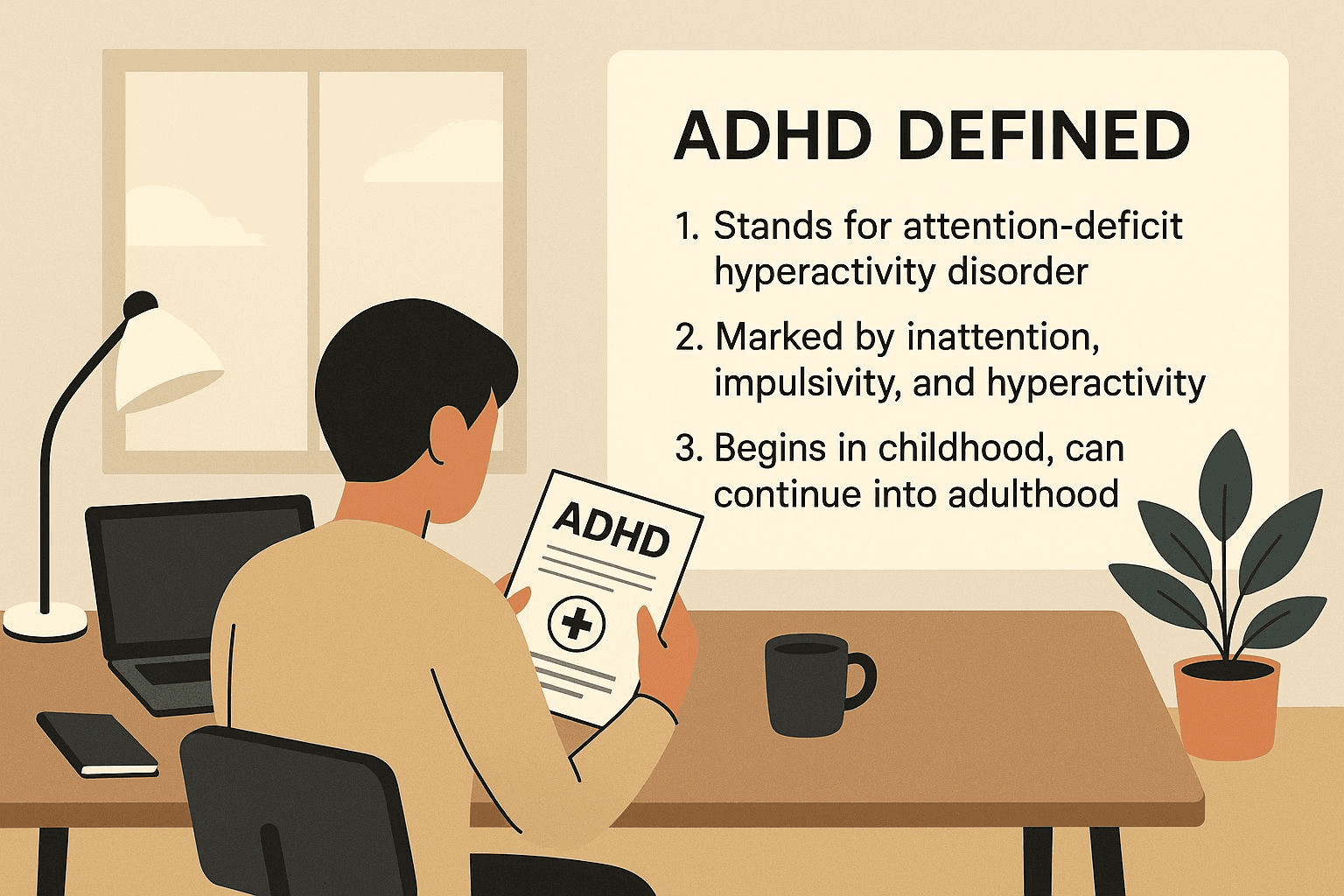
A formal ADHD diagnosis is often the first step. For legal protection, the next step is showing how symptoms affect your ability to function in daily life, work, or school.
That means documenting real limits, not just listing symptoms. For example, ADHD may affect concentration, task initiation, working memory, reading, learning, organization, or deadline management.
How Different Laws View ADHD
The question "is ADHD a disability?" gets different answers depending on which law you're looking at.
In the U.S., three key pieces of legislation offer protections, but each one focuses on a different environment:
The Americans with Disabilities Act (ADA) primarily covers employment and public access.
Section 504 of the Rehabilitation Act applies to programs or activities that get federal funding, which includes many schools and workplaces.
The Individuals with Disabilities Education Act (IDEA) is all about the needs of students in the K-12 public school system.
These legal frameworks are so important because ADHD is incredibly common. In the U.S. alone, about 11.3% of children aged 5 to 17 have been diagnosed, which shows just how much it impacts our schools.
If you want to see the bigger picture, you can review more learning disability statistics for additional context.
ADHD Disability Status at a Glance
Navigating these laws can feel a bit overwhelming, so here's a quick table to break down how each framework treats ADHD.
Framework / Context | Is ADHD Considered a Disability? | Primary Focus |
|---|---|---|
Americans with Disabilities Act (ADA) | Yes, if it substantially limits a major life activity. | Workplace and Public Accommodations |
Section 504 | Yes, provides protections in federally funded settings. | Equal Access in Education and Employment |
Individuals with Disabilities Ed. Act (IDEA) | Yes, under the "Other Health Impairment" category. | Specialized Educational Services (e.g., an IEP) |
As you can see, the answer is generally "yes," but the context and the specific protections offered will change depending on whether you're in a classroom, at your job, or accessing public services.
How to Secure Accommodations at Work and School
Knowing ADHD qualifies as a disability under the law is one thing.
Actually getting the support you need is a separate step.
Securing "reasonable accommodations" isn't a passive process, it requires you to be your own best advocate, with clear communication and the right paperwork to back it up.
Think of it as building a bridge.
On one side are your unique skills and talents, and on the other are your job duties or academic goals. Accommodations are the bridge that spans the gap created by executive function challenges, allowing you to cross over and succeed.
The Roadmap to Requesting Accommodations
Advocating for yourself starts long before you ever step into a meeting with HR or a school administrator. It begins with building a solid case for yourself, where you're both the client and the lead attorney.
The path forward is pretty clear, and it usually involves these key steps:
Get a Formal Diagnosis: This is non-negotiable. To get official accommodations, you need documentation from a qualified healthcare professional, like a psychiatrist or psychologist, confirming your ADHD diagnosis.
Gather Detailed Documentation: Your diagnosis is just the start. The documentation needs to clearly explain how your ADHD symptoms substantially limit major life activities. Does it impact your ability to concentrate, organize, or manage your time? Be specific.
Identify Your Specific Needs: Before asking for anything, get clear on your biggest hurdles. Do deadlines sneak up on you? Is a noisy office your hardest trigger? Pinpointing these challenges helps you request accommodations that are actually effective.
The goal isn't to ask for special treatment. It's about requesting the specific tools and adjustments that will allow you to do your job or meet academic requirements on equal footing with everyone else.
For companies that want to build a truly supportive environment, it's also about looking at the bigger picture. This includes things like adopting fair hiring practices for remote teams to create an inclusive culture from the very beginning.
Common and Effective Accommodations
The term "reasonable accommodation" is intentionally flexible because there's no single solution for ADHD. What's a major help for one person might not help another at all. The key is to find adjustments that are effective for you without creating an "undue hardship" for your employer or school.
Here's a look at some common and highly effective accommodations that can make a real difference.
Common Accommodations for ADHD
Area of Challenge | Workplace Accommodation Example | School Accommodation Example |
|---|---|---|
Time Management & Deadlines | - Flexible work hours. | - Extended time on tests and assignments. |
Distraction & Focus | - Noise-canceling headphones. | - Preferential seating (e.g., away from windows or doors). |
Organization & Memory | - Access to task-management software. | - Permission to record lectures. |
These examples are just a starting point. The best accommodations come from a collaborative conversation about what you need to perform at your best.
Assistive Technology as an Accommodation
Sometimes the best accommodation is a practical tool. Speech-to-text can help when ADHD makes it hard to start a blank page, keep a thought in working memory, or turn spoken ideas into written work.
Voicy can fit that kind of accommodation for reports, emails, class notes, browser forms, and essays. It offers a free trial, then paid plans, and uses cloud-based transcription across Mac, Windows, browser extension, iOS, and Android. If cost is part of the barrier, Voicy also has a disability discount.
For students, the right mix might include written instructions, recorded lectures, speech-to-text, reminders, and simpler study routines. Learning effective ADHD study tips can help you choose the tools that actually match your brain.
Understanding ADHD as an Executive Function Disorder
To get why ADHD is considered a disability, we have to look past the old myth that it's just about being hyperactive.
At its very core, ADHD is a disorder of executive functions.
Your executive functions are like the air traffic control system of your brain.
These function manage everything from:
Organizing tasks
Handling new information
Keeping emotions in check
Controlling where your attention goes
The "CEO of the brain" that plans your day, starts a project, or stops you from focusing.
For a person with ADHD, that internal control tower can get completely overwhelmed.
Signals get crossed, priorities become a jumbled mess, and unimportant information can demand more headspace than real priorities.
This isn't about a lack of willpower; it's a real, neurodevelopmental difference in the brain's wiring.
The Three Main Presentations of ADHD
ADHD isn't a one-size-fits-all condition. It shows up in different ways, and clinicians group these into three main "presentations." Knowing them helps us see the true, real-world impact.
Predominantly Inattentive Presentation: This is what many people used to call "ADD." It's marked by challenges with staying organized, paying attention to details, and actually finishing what you start.
Predominantly Hyperactive-Impulsive Presentation: This is the more "classic" picture most people have of ADHD. It involves a nearly constant need for motion like fidgeting, tapping, squirming in a chair. Impulsivity is another huge piece, leading to interrupting others, making snap decisions without thinking, or finding it impossible to wait for their turn.
Combined Presentation: This is the most common form of ADHD, where someone meets the criteria for both inattentive and hyperactive-impulsive symptoms. They might struggle to organize a big project and find it physically painful to sit still through a long meeting.
The Diagnostic and Statistical Manual of Mental Disorders (DSM) has long recognized ADHD as a neurodevelopmental disorder. It focuses on how symptoms create real impairment in social, academic, or occupational functioning, which is the basis for meeting disability definitions.
This clinical view is supported by decades of research. Historically, studies have pointed to a global average prevalence of ADHD symptoms impacting around 4-5% of people across various countries. You can dig deeper into the global prevalence and diagnostic criteria from this study.
The bottom line is that ADHD creates real, recognized challenges that go way beyond simple distraction. This is what forms the foundation for its classification as a potential disability.
How the Law Defines ADHD as a Disability
To really get to the heart of the question, "Is ADHD a disability?", we have to look at it through a legal lens. It's not as simple as just having a diagnosis. The law cares less about the label and more about its real-world impact on your life.
In the United States, the big one is the Americans with Disabilities Act (ADA). This is the bedrock of disability rights.
The ADA has a few ways to define a disability, but the most common path involves showing you have a physical or mental impairment that substantially limits one or more major life activities. This is exactly where an ADHD diagnosis becomes legally significant.
Think of it like building a legal case. Your diagnosis is the first piece of evidence, but the real work is showing what a "major life activity" is and proving how ADHD "substantially limits" it.
Connecting ADHD to Major Life Activities
That term, "major life activity," might sound overly formal, but it's actually incredibly broad. It covers the basic, everyday functions that many people don't even have to think about. Thankfully, the ADA Amendments Act of 2008 made the list very inclusive.
Many of these activities are directly affected by the core symptoms of ADHD:
Concentrating and Thinking: This is one of the clearest examples. The daily battle to stay focused in a meeting, tune out the noise of an open-plan office, or just think clearly when the pressure is on fits perfectly here.
Learning and Reading: If you struggle to absorb what you read, keep up in a lecture, or remember what you just studied, you know how much ADHD can impact learning. This is a huge challenge for students and professionals alike.
Working: This is a catch-all that covers all the little things needed to do a job well. We're talking about hitting deadlines, keeping projects organized, and communicating effectively with your team.
Major Bodily Functions: Here's an important one many people miss. The ADA also recognizes functions of the brain, like neurological and brain functions, as major life activities. Since ADHD is a neurodevelopmental condition, it directly impairs these fundamental brain processes.
The key is demonstrating that the limitation is "substantial." This doesn't mean you're completely unable to do something. It just means your ability to do it is significantly restricted compared to the average person.
What "Substantial Limitation" Looks Like
"Substantial limitation" isn't about total failure. It's about the sheer amount of extra time, effort, and strategic maneuvering it takes to get to the same finish line as everyone else.
For example, a neurotypical person might crank out a report in two hours. Someone with ADHD might take six hours to finish the very same report because of challenges with focus, organization, and just getting started. That massive difference in time and effort is a perfect illustration of a substantial limitation.
Protections Beyond the ADA
While the ADA is a huge deal for work and public life, two other laws offer crucial protections, especially in school settings:
Section 504 of the Rehabilitation Act: This law prevents discrimination in any program or activity that gets federal funding. That includes public schools, universities, and even some private schools. It defines disability in a very similar way to the ADA.
Individuals with Disabilities Education Act (IDEA): This one is specifically for students in K-12 public schools. ADHD often qualifies a student for an Individualized Education Program (IEP) under the "Other Health Impairment" category, especially if it's getting in the way of their educational progress.
Understanding these laws is incredibly empowering. For anyone navigating these systems, it also helps to explore tools and resources that can level the playing field. Many companies offer support, and it's worth learning more about programs like a disability discount for assistive technology.
Knowing your rights is always the first step. From there, you can advocate for the support you need to not just get by, but to truly succeed.
The Real-World Impact of ADHD on Daily Life
Legal definitions don't even begin to capture what it's actually like to live with ADHD.
ADHD is about the very real, often invisible, hurdles that executive function challenges throw in your path, every day.
The whole "is ADHD a disability?" question becomes much clearer when you look at its effects throughout your life.
While many people think of it as a childhood condition, ADHD doesn't just magically vanish when you turn 18.
Research shows its symptoms and the difficulties they cause stick around through the teen years and well into adulthood.
For example, studies estimate prevalence rates at 11.4% in children aged 6-12 and around 8% in those aged 12-18. The fact that these challenges show up across school, social life, and eventually the workplace is what really solidifies its impact.
You can dig into more findings on ADHD's lifespan impact to see the data for yourself.
Challenges in the Workplace
For an adult with ADHD, the professional world can feel like navigating an obstacle course blindfolded.
It has absolutely nothing to do with a lack of intelligence or skill. Instead, it's about fighting against invisible barriers that make seemingly straightforward tasks feel monumental.
This often shows up in a few key ways:
Missed Deadlines: When a project is due in a few weeks, it can feel abstract and not "real" until it's suddenly due tomorrow. This "time blindness" turns long-term planning into a constant, stressful scramble.
Difficulty with Organization: Trying to keep track of a flood of emails, project files, and action items can be completely overwhelming. The brain's internal filing system can feel chaotic, leading to lost information and time spent just trying to find things.
Inconsistent Focus: An open-plan office can be a sensory nightmare. The inability to filter out nearby conversations, footsteps, or other movements makes deep, concentrated work feel almost impossible on some days.
Tools do not replace accommodations, but they can make the right accommodation easier to use. If time blindness is the main problem, start with ADHD time management tools. If task switching and writing friction are bigger issues, compare ADHD productivity tools and a cross-app dictation workflow.
Hurdles in Education and School
In a classroom setting, the very structure of traditional learning can be at odds with how the ADHD brain processes information. Students often feel immense pressure to fit into a system that simply wasn't designed for their neurotype.
Think about it: a student might struggle to follow a long lecture, not because they're bored or uninterested, but because their mind keeps pulling them toward other thoughts. Juggling assignments for multiple classes, organizing notes, and studying for big exams can feel like climbing a mountain without the right gear.
The core issue isn't a failure to try; it's a genuine neurological difference. The constant effort required just to keep up can be mentally and emotionally draining, leading to burnout and low self-esteem.
For anyone dealing with these daily impacts, professional ADHD therapy or coaching can help. So can simple supports like lecture recordings, written assignment steps, extended test time, and tools that reduce the amount of typing required.
The Personal and Social Toll
Beyond work and school, ADHD's influence cuts deep into personal life. Managing a household can be a major source of stress, with essential chores like paying bills on time or keeping up with laundry consistently falling through the cracks.
Relationships can feel the strain, too. Emotional dysregulation, a common but often misunderstood symptom, can lead to intense emotional reactions that partners, friends, and family find difficult to navigate. This can create a painful cycle of misunderstanding and conflict, leaving the person with ADHD feeling deeply isolated.
Reframing ADHD From Disability To Difference
While the legal term "disability" is a crucial key for unlocking protections and accommodations, it honestly only tells half the story. If we only look at ADHD through a lens of what's missing, we completely overlook the unique and often brilliant ways the ADHD brain actually works.
Changing our perspective to one of neurodiversity allows for a much more balanced and empowering view.
This isn't about glossing over the real-world challenges. Not at all. It's about recognizing that with the right environment and support, some of the most classic ADHD traits can transform into incredible strengths. The conversation shifts from "what's wrong with you?" to "what makes you think differently?"
From Deficit To Difference
Lots of people with ADHD discover that their brain's unique wiring gives them a serious edge in certain situations. The very same mind that can't bear to focus on a boring spreadsheet might snap into an intense state of hyperfocus on a project they're passionate about, putting in hours of incredibly productive work.
This different way of processing the world often sparks:
Out-of-the-Box Creativity: A non-linear thought process is fantastic at connecting seemingly random ideas. This can lead to innovative solutions that more linear thinkers might completely miss.
Rapid Problem-Solving: The knack for seeing a problem from ten different angles at once makes many people with ADHD amazing in a crisis or when a fast decision is needed.
High Energy and Drive: When that boundless energy is channeled into a field they genuinely love, it becomes a powerful force for creating, building, and getting things done.
The real goal is to build an environment where these differences aren't just tolerated, they're encouraged to flourish. It's about creating scaffolds, like helpful tools and flexible schedules, that lower the hurdles and let the inherent strengths of the ADHD mind shine.
For many people, this includes assistive technology. The support principles often overlap with dyslexia, especially around reading, writing, memory, and fatigue. If that is relevant for you too, compare assistive technology for dyslexia.
Common Questions About ADHD and Disability Rights
Navigating your rights can feel overwhelming, but getting clear answers is the first real step toward advocating for yourself. Here are some of the most common questions people have when figuring out how to handle their ADHD in a professional or academic setting.
Do I Have to Tell My Employer I Have ADHD?
No, you are never legally required to disclose your ADHD. Your medical information is private and protected.
However, there's a catch. To receive legal protections and reasonable accommodations under the ADA, you do need to disclose your condition to the right people, usually HR or a direct manager, and provide the necessary paperwork.
What Documentation Do I Need for Accommodations?
You'll almost always need a formal diagnosis from a qualified healthcare professional, like a psychiatrist or psychologist.
This documentation needs to do more than just state your diagnosis. It should clearly explain how your ADHD symptoms substantially limit one or more major life activities. This connection is what builds the case for your accommodation request.
The key is connecting the diagnosis to its functional impact. The paperwork proves you have a recognized condition and shows why you need support to perform on a level playing field with everyone else.
Can I Get Fired for Having ADHD?
No. The Americans with Disabilities Act (ADA) protects qualified employees from being fired just because they have a disability.
As long as you can perform the essential functions of your job, either with or without reasonable accommodations, you're protected from discrimination. At the end of the day, your performance is what matters, not your diagnosis.


